
Did you know millions play Wordle worldwide? It’s a daily word game that’s simple yet challenging. Players look for effective strategies to win more. As we enter 2026, having a good Wordle strategy is key.
We think the right Wordle trick can greatly boost your winning chances. In this article, we’ll talk about the importance of strategy in Wordle. We’ll also share a simple yet effective technique to up your win rate. By the end, you’ll want to try this trick and see your game improve.
Key Takeaways
- Understand the basics of Wordle and its gameplay.
- Learn why a strategic approach is necessary for success.
- Discover a simple Wordle trick to improve your win rate.
- Explore effective Wordle tips and Wordle strategy.
- Apply the trick to your daily Wordle game for better results.
The State of Wordle in 2026
As we enter 2026, Wordle has changed a lot since it started. The New York Times bought it, making it a hit with millions of players around the world.
How Wordle Has Evolved Since Its Creation
Wordle has grown in many ways since it began. It started as a simple word game but now has more features and challenges. Its fame grew even more after the New York Times took it over, reaching more people.
Common Challenges Players Face Today
Even though Wordle is simple, it still has tough parts. Guessing the right five-letter word in six tries is hard. Players also struggle with daily Wordle puzzles, which are tricky.
Players often make mistakes like not using letter frequency well. They also don’t change their strategy based on the game’s color hints. Knowing these issues helps us see why we need good strategies to win at Wordle.
The Letter Frequency Analysis: The Ultimate Wordle Trick
Improving your Wordle win rate starts with a simple yet powerful trick: letter frequency analysis. This method helps you understand how often letters appear in English. It boosts your guessing strategy.
What Is Letter Frequency Analysis?
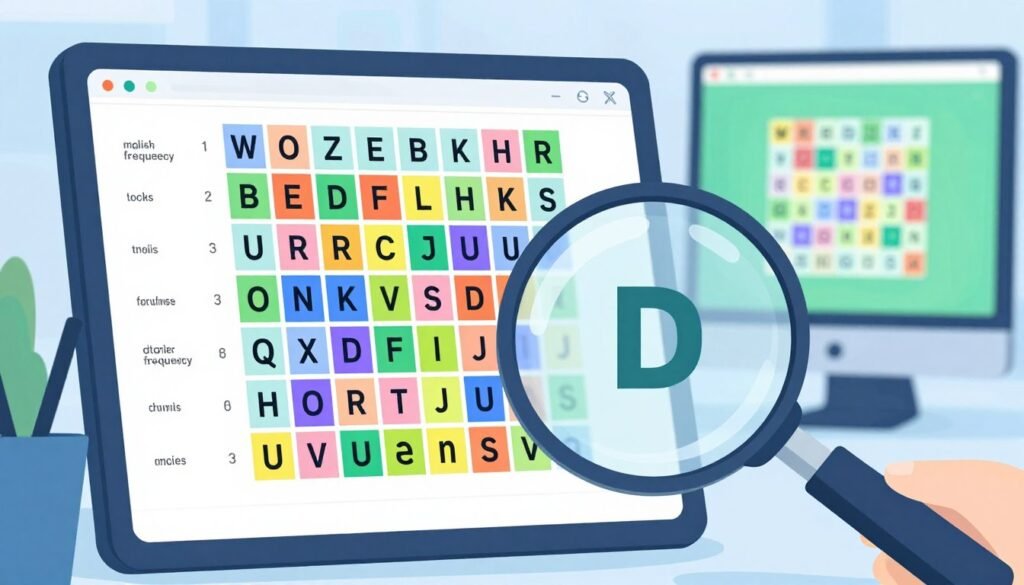
Letter frequency analysis is a statistical method to find out how often letters appear in a language. In Wordle, it helps players guess better by knowing which letters are used more often. Letters like E, A, and O are more common than Q, X, and Z.
This technique is not just about knowing single letters. It’s also about how they come together in words. It requires a basic grasp of English letter distribution.
Why This Technique Is Game-Changing for Wordle
The letter frequency analysis is a game-changer for Wordle. It gives players a systematic way to guess. Instead of guessing randomly or using memorized lists, players use statistical insights.
This method not only boosts winning chances but also makes the game more fun and strategic. By using letter frequency analysis, players gain a deeper understanding of the game’s structure. This leads to better success rates and a more enjoyable game.
The Statistical Advantage of Frequency-Based Guessing
Frequency-based guessing has a big statistical advantage. By focusing on common letters, players increase their chances of getting the right letters early. This strategy works well when combined with other tactics, like recognizing patterns.
The statistical advantage comes from the English language’s predictable letter distribution. By using this predictability, players can make smarter guesses and do better overall.
How to Apply Frequency Analysis to Your Wordle Game
Winning at Wordle starts with a smart strategy. This includes using frequency analysis. It helps you guess words by knowing which letters are most common in English. This method boosts your winning chances.
Understanding English Letter Distribution
Letters in English don’t appear equally. Some, like E, A, O, T, I, and N, are used more often. Knowing this helps you guess better in Wordle.
Sort letters by how often they’re used. Focus on the most common ones first. Here are the top 5 in 5-letter words:
- E
- A
- O
- T
- I
Choosing these letters for your first guesses increases your chances of getting some right.
Crafting the Perfect First Word
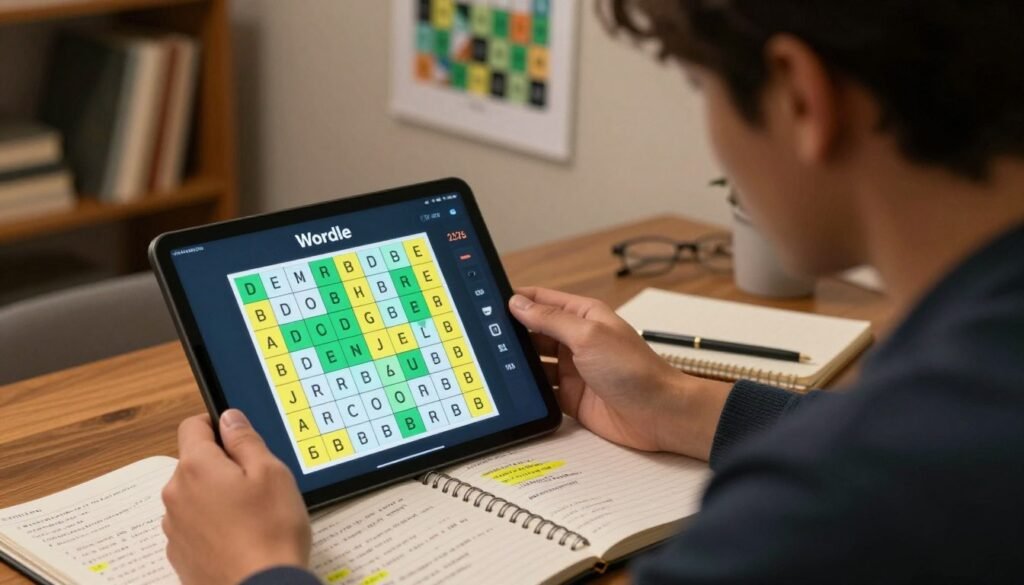
Choosing the right first word is key. It should have lots of common letters. “House” is a good choice because it has H, O, U, S, and E.
Other good first words include:
- Arise
- Audio
- Alert
These words have many common letters, making it more likely to get some right.
Optimizing Your Second Guess
After your first guess, use the feedback to improve your second guess. If you got common letters right, use that info for your next guess.
For example, if “house” gave you “O” and “E” right, use those letters in your next word. Try words with these letters in different spots to learn more.
- Find out which letters were right and where.
- Use these letters in new ways in your next guess.
- Don’t use letters that were wrong in your first guess.
Using Color Feedback to Narrow Possibilities
Wordle gives you color hints to help guess. Green means a letter is right where you placed it. Yellow means it’s right but not in that spot. Gray means it’s wrong.
To use these hints well:
- Keep green letters in the same spot in your next guesses.
- Try yellow letters in different spots to find their correct place.
- Don’t guess with gray letters again.
Using these hints smartly helps you guess the word faster and more accurately.
Advanced Strategies to Complement the Frequency Trick
Using frequency analysis alone is powerful, but adding other strategies can boost our Wordle skills. We’ll explore these techniques to see how they work with our frequency trick. This will help us solve Wordles more effectively.
Recognizing Word Patterns and Common Structures
One key strategy is to spot word patterns and common structures. Many English words share certain patterns, like consecutive vowels or common consonant pairs. Learning these patterns helps us guess better, mainly in the game’s later stages.
Knowing that suffixes like “-ed” or “-ing” are common can narrow down our guesses. Also, recognizing vowel combinations or double consonants can guide us. This, combined with frequency analysis, makes our guesses more informed.
When to Switch from Frequency to Pattern Recognition
Knowing when to switch from frequency analysis to pattern recognition is key. After the first couple of guesses, look for patterns if the letters don’t immediately solve the puzzle. This isn’t about giving up on frequency analysis, but adapting as we get more info.
For example, if our early guesses give us consonants but no vowels, we might look for common vowel patterns or word families that match the consonants we’ve found.
Tools and Resources to Support Your Frequency Analysis
To boost our Wordle strategy, we can use various tools and resources. Online archives and word lists offer insights into common Wordle solutions. They help refine our frequency analysis. Also, linguistic resources on letter distributions and word patterns are very helpful.
Popular tools include Wordle solvers and linguistic databases. These tools analyze possible words and offer insights into word structures and letter frequencies. By using these resources, we can keep improving our strategy and stay competitive in the game.
Conclusion: Transforming Your Wordle Success Rate
Using letter frequency analysis can really boost your Wordle wins. It’s a simple method that helps you guess words better. You learn about letter patterns in English to make smarter guesses.
Choosing the right first word and guessing well after that can help a lot. Adding advanced strategies like spotting word patterns can make your game plan unbeatable. This way, you can create a guaranteed wordle strategy that suits you.
Whether you’re new to Wordle or have been playing for a while, the secret to getting better is practice. Changing how you play Wordle can not only make you better but also more fun. It’s all about improving your wordle success rate and enjoying the game more.
As you keep playing and getting better, solving the daily puzzle will get easier. You’ll see your success rate go up. With these wordle winning tips, you’re on your way to becoming a Wordle champion. Your game will get much better.
FAQ
What is Wordle, and how do I play it?
Wordle is a daily word-guessing game. We try to guess a 5-letter word in 6 attempts or less. We guess a word and get feedback in colors. Green means a letter is right in the right spot, yellow means it’s right but not in the right spot, and gray means it’s wrong.
What is the best starting word for Wordle?
A good starting word for Wordle should have common letters. Try using “house” or “arise” first. These words have a mix of vowels and consonants that are often found in many words.
How does letter frequency analysis work in Wordle?
Letter frequency analysis is about guessing words with common letters. This strategy helps us get more correct letters early on. It makes solving the puzzle easier.
Can I use online tools to help me with Wordle?
Yes, online tools like word lists and anagram solvers can help. But don’t rely too much on them. They can make the game less fun and challenging.
How can I improve my Wordle win rate?
To win more at Wordle, practice often and develop a good strategy. Stay updated with new techniques like letter frequency analysis. Analyzing past games can also help you improve.
Is there a way to solve Wordle in 3 attempts or less?
Solving Wordle in 3 attempts or less is tough but possible. Use letter frequency analysis and strategic guessing. This can help you solve it quickly.
What is the difference between Wordle normal mode and hard mode?
In normal mode, you can guess any 5-letter word. In hard mode, you must use letters from previous guesses. Hard mode is more challenging and requires smarter guessing.