

Did you know millions play the daily Wordle game worldwide? It’s simple yet challenging, making it a daily favorite for many.
But, not everyone wins on the first try. Making a bad guess is common for Wordle players. Don’t worry, we’ve got tips to help you bounce back and win.
We’ll show you how to analyze mistakes and adjust your strategy. You’ll learn to make the most of your guesses. By the end, you’ll be ready to tackle the daily Wordle with confidence.
Key Takeaways
- Understand the importance of strategy in playing Wordle.
- Learn how to analyze your mistakes and adjust your approach.
- Discover tips to maximize your chances of winning.
- Improve your word guessing skills with our expert advice.
- Enhance your overall Wordle gameplay experience.
What Makes a First Guess “Bad” in Wordle
Knowing what makes a first guess “bad” in Wordle is key to getting better. A bad first guess can lead to more bad guesses. This makes it hard to solve the puzzle before running out of tries.
Defining Unsuccessful Opening Words
An unsuccessful opening word in Wordle doesn’t give us useful info about the target word. It might lack common letters or have a bad mix. For example, a word with many vowels might not help if the target word has fewer.
Common First-Guess Pitfalls
There are a few common mistakes that can make our first guess not work well. These include:
- Using words with very uncommon letters or letter combinations.
- Not considering the distribution of letters in the English language.
- Ignoring the importance of vowels in forming the core of many words.
Let’s look at some common mistakes in a table:
| Pitfall | Description | Example |
|---|---|---|
| Uncommon Letters | Using words with letters that are less frequent. | Words like “quizz” or “xray” |
| Ignoring Vowel Distribution | Not considering how vowels are distributed in 5-letter words. | Guessing a word without a vowel as the second or third letter |
Why Recovery Strategy Matters
Having a recovery strategy is crucial. It lets us change our plan based on our first guess. By looking at green, yellow, and gray letters, we can make better guesses. This boosts our chances of solving the puzzle.
By understanding Wordle and avoiding common mistakes, we can improve our recovery strategy. This turns a bad first guess into a chance for success.
Immediate Actions After a Poor Opening
A bad first guess in Wordle is not the end. It’s a chance to rethink and change your plan. Understanding the feedback is key.
Analyzing Your Green, Yellow, and Gray Feedback
Wordle gives you colored tiles for feedback. Green means a letter is right where it should be. Yellow means it’s right but in the wrong spot. Gray means it’s wrong.
Understanding these colors is crucial for your next step. For example, a green tile for “E” in the third spot means “E” is in the word and in the right place.

Crafting a Strategic Second Guess
With feedback in mind, your second guess should be smart. Use yellow or green letters in different spots to learn more. A consonant-heavy approach helps if you’re unsure about vowels.
| Letter Color | Interpretation | Action |
|---|---|---|
| Green | Correct letter, correct position | Keep in the same position |
| Yellow | Correct letter, wrong position | Try in a different position |
| Gray | Incorrect letter | Avoid in future guesses |
Maintaining Your Wordle Composure
It’s easy to get upset after a bad first guess. But staying calm is important.
“The greatest glory in living lies not in never falling, but in rising every time we fall.” – Nelson Mandela
Being calm helps you think better and make smarter guesses.
By understanding feedback, making a smart second guess, and staying calm, you can turn things around.
Strategic Wordle Recovery Techniques
A bad first guess in Wordle is not the end. It’s a chance to use smart recovery strategies. When we guess wrong, we need to change our plan to learn more about the word.
The Information-Gathering Approach
First, we analyze the game’s feedback. We look at green, yellow, and gray letters. This tells us which letters are in the right spot, which are in the wrong spot, and which aren’t in the word.
The Consonant-Heavy Recovery Method
Guessing consonant-heavy words is a good strategy for the second try. Many English words have consonant clusters. Words with “th,” “ch,” or “sh” are often helpful.
The Vowel-Focused Comeback Strategy
Another way is to focus on vowels. Vowels are key in most words. Finding them can help us narrow down our guesses.
Targeting Common Vowel Patterns
Look for common vowel pairs like “ea,” “ee,” or “oa.” These are common in English and can help us guess letters.
Vowel Position Analysis
It’s also important to think about where vowels can go in the word. For example, if “e” is not first, try it in other spots to make possible words.
Here’s how these strategies work together:
| Strategy | Description | Example |
|---|---|---|
| Information-Gathering | Analyze green, yellow, and gray letters | Guess: “house” – Result: h (green), o (yellow), others (gray) |
| Consonant-Heavy | Guess words with multiple consonants | Next Guess: “stretch” |
| Vowel-Focused | Identify common vowel patterns | Next Guess: “boast” |
Using these strategies can really help us solve Wordle. Whether we focus on info, consonants, or vowels, the key is to adjust our plan based on what we learn.
Pattern Recognition for Wordle Comebacks
Improving at Wordle can start with recognizing patterns. After a bad start, analyzing your first guess can help. You can find word patterns and change your strategy.
Identifying Partial Word Structures
Wordle feedback helps you understand the word’s structure. Green letters tell you where a letter is right. This info is key to building your next guess.
For example, if “e” is in the third spot, think of words with “e” there. Common letter combinations can also guide you.
Working with Letter Position Constraints
Letter positions are vital in Wordle. Yellow letters mean a letter is in the word but not where you guessed. You must try different arrangements.
Using yellow and green letters, you can guess the word’s shape. This method takes patience and practice but is a solid way to solve the puzzle.
Building Word Frameworks from Limited Data
Start with what you know to build word frameworks. Single green letter strategies use that letter as a base to guess others.
Single Green Letter Strategies
With one green letter, look for common word patterns. For instance, if “t” is green in the second spot, find words with “t” there.
Multiple Yellow Letter Approaches
With many yellow letters, the goal is to mix them into possible words. Think about where each letter could go in a valid word.

Using these strategies can boost your Wordle skills. Better pattern recognition can turn a losing game into a win.
Word Elimination and Narrowing Techniques
To get better at Wordle, learning to eliminate and narrow down words is key. These methods help players cut down the number of possible words. This makes solving the puzzle easier and faster.
Systematically Reducing Your Word Pool
One good way to play Wordle is to remove words based on the game’s feedback. After each guess, the game shows green, yellow, and gray letters. Green means the letter is in the right spot, yellow means it’s in the word but not right, and gray means it’s not in the word.
For example, if a guess has many gray letters, you can cross off words with those letters. This makes finding the right word easier.
Leveraging Gray Letters Effectively
Gray letters are very helpful in Wordle. They tell you which letters are not in the word. Keeping track of these letters helps you rule out many words.
Let’s say “Q” is gray. Any word with “Q” can be ruled out. Using this info with green and yellow letters helps narrow down the word pool.
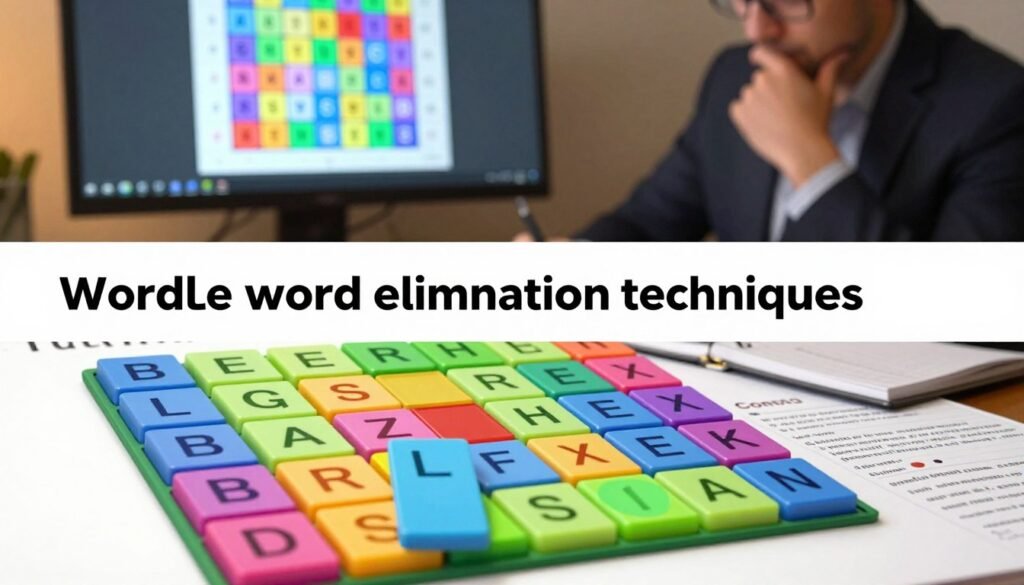
Mental Mapping of Possible Solutions
Mental mapping is about creating a picture of possible words based on the feedback. By using green, yellow, and gray letters, players can build a list of possible words.
| Letter Position | Possible Letters | Eliminated Letters |
|---|---|---|
| 1st Position | A, E, O | Q, X, Z |
| 2nd Position | T, S, R | B, C, D |
| 3rd Position | N, M, L | F, G, H |
By reducing the word pool, using gray letters, and mentally mapping words, players can solve Wordle better. These strategies, along with smart guessing, can lead to success.
Real-World Examples of Wordle Recoveries
Let’s explore some amazing stories of Wordle victories. These tales show how smart gameplay can turn a bad start into a win. They prove that even after a tough first guess, you can still win.
Case Study: From “QUITS” to Victory
One player started with “QUITS,” thinking it was a bad choice. But, they found out “U” and “S” were in the correct word. They used this info to guess the word in five tries. The key takeaway is to use feedback to guide your next guesses.
Case Study: Recovering After Zero Correct Letters
Guessing zero letters first is tough. A player used a vowel-heavy strategy to guess words with common vowels. This plan worked on their fourth try. The strategy involved smart guesses based on letter frequency and patterns.

Case Study: Navigating Tricky Word Patterns
In a tough game, a player faced a word with a unique pattern. They used partial word structures and letter positions to find the word. They guessed it by adding to what they learned from earlier tries. Important strategies included using gray letters wisely and keeping track of possible answers.
These stories show that with the right tactics and determination, you can overcome a bad start in Wordle and win.
Conclusion: Mastering the Wordle Comeback
Recovering from a bad first guess in Wordle takes strategy and practice. We can improve by analyzing our first feedback and making a smart second guess. Techniques like pattern recognition and word elimination also help a lot.
A good Wordle comeback isn’t just luck. It’s about using a solid strategy to guide us. With the right mindset and techniques, we can change a losing game into a win. This way, we find the Wordle winning formula that suits us.
With dedication and the right approach, we can make sure we never lose at Wordle again. By practicing and improving, we get better at facing Wordle’s challenges. This leads to more victories for us.
FAQ
What is Wordle and how do I play it?
Wordle is a daily word-guessing game. We try to guess a 5-letter word in 6 attempts or less. We guess a word and get feedback in the form of colored tiles.
What makes a good starting word for Wordle?
A good starting word has common letters and vowels. Words like “house” or “arise” are good. We can also use words with multiple vowels or consonants to get more info.
How do I analyze the feedback from Wordle?
We analyze feedback by looking at colored tiles. Green means correct letters in the right spot, yellow means correct but wrong spot, and gray means wrong. This helps us guess better next time.
What is the best strategy for recovering from a bad first guess in Wordle?
The best strategy is to analyze feedback and make a smart second guess. Focus on vowels, consonants, or patterns to solve the puzzle.
Can I use a Wordle solver or cheat tool?
There are Wordle solvers and cheat tools, but we should play without them. It’s better to improve our skills and enjoy solving the puzzle ourselves.
How can I improve my Wordle skills and solve the puzzle faster?
To improve, practice regularly and learn from mistakes. Use strategies like pattern recognition and word elimination. Studying the game’s mechanics and common letter patterns also helps.
Is there a way to access past Wordle answers or puzzles?
Yes, we can check the New York Times Wordle archive for past puzzles and answers. It helps us learn and get better at the game.
Can I play Wordle in different modes or difficulty levels?
Yes, Wordle has Normal and Hard modes. Hard mode is more challenging, requiring correct letters in subsequent guesses.
How can I share my Wordle results or compete with others?
We can share our results on social media or with friends. Copy the colored tile feedback into a post or message. We can also join online communities to discuss and compete.