Top Wordle Openers Ranked by Win Rates
One Wordle player starts with CRANE and solves the puzzle in three guesses. Another begins with JUMPY and struggles all the way to guess six. The difference isn’t intelligence or luck. It’s probability. Over the years, Wordle enthusiasts have analyzed thousands of games, comparing opening words, letter frequency, and average solve rates. The results reveal that some starting words consistently outperform others, making them the top choices for players who want faster wins and higher success rates.
Which Are the Top Wordle Openers Ranked by Win Rates?
The best Wordle openers share a simple goal: reveal as much information as possible on the very first guess.
Researchers and Wordle statisticians often evaluate starter words based on:
- Letter frequency
- Vowel coverage
- Consonant efficiency
- Information gained per guess
- Average remaining solutions after the first move
English language analysis shows that E, A, R, S, T, N, and O appear more frequently than most other letters. Successful opening words tend to include several of these letters.
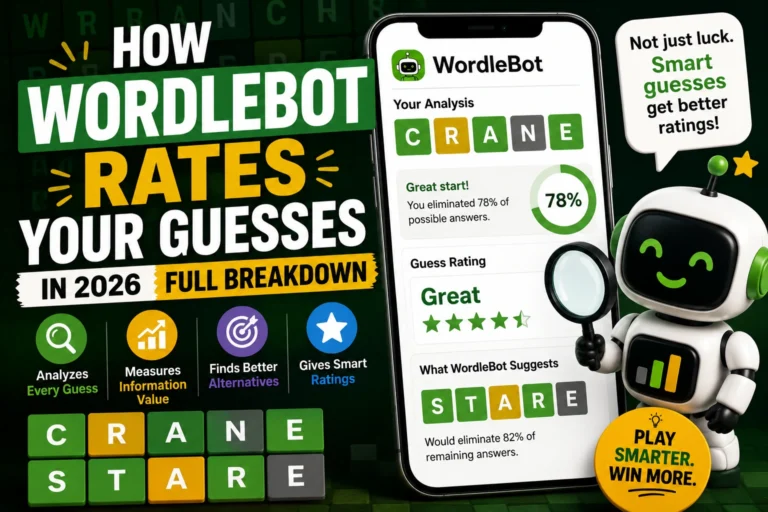
Here are some of the Top Wordle Openers Ranked by Win Rates based on commonly cited statistical analyses:
| Opener | Main Strength |
|---|---|
| SLATE | Excellent letter coverage |
| CRANE | Strong consonant balance |
| STARE | High-frequency letter combination |
| TRACE | Effective position testing |
| CRATE | Balanced vowel and consonant mix |
| ARISE | Strong vowel discovery |
| ROATE | Popular among Wordle analysts |
Take SLATE as an example.
If the hidden answer is HEART, your first guess instantly confirms:
- A exists
- T exists
- E exists
At the same time, it eliminates S and L.
That single move removes a huge number of possible solutions.
Some Wordle solver studies suggest that optimized opening words can reduce average solution attempts by nearly 15% to 20% compared to random starting words. While no opener guarantees success, strong statistical choices consistently improve long-term performance.
The reason these words rank highly is simple. They provide valuable information quickly and help narrow the solution space faster than less efficient alternatives.
Why Win Rates Matter More Than Immediate Success
Many players judge a starter word by how often it finds green letters.
That’s not actually the best measurement.
A more important metric is how effectively a word reduces uncertainty.
Imagine you’re searching for a specific book in a library containing thousands of titles. Finding the exact shelf matters, but first you need to identify the correct section. Wordle works similarly.
A unique insight many players miss is that a good opener doesn’t need to reveal many green tiles. It simply needs to eliminate possibilities.
For example:
- CRANE may reveal only one yellow letter.
- Yet it can eliminate hundreds of candidate words.
That’s still a successful opening move.
Research into Wordle-solving algorithms has shown that some statistically optimized words leave fewer than 100 possible answers after the first guess. Poor openers may leave several hundred possibilities still in play.
Think of your first Wordle guess as a flashlight. The brighter the light, the more clearly you can see the path ahead. The strongest openers illuminate large sections of the puzzle immediately, making future guesses more effective.
This is why experienced players often prioritize information gathering over chasing an early solve.
How to Use High-Win-Rate Wordle Openers Effectively
Choosing a strong opening word is only part of the strategy. The real advantage comes from how you use the information it provides.
Follow these steps to maximize your results.
1. Choose One Proven Opener
Select a starter with a strong statistical reputation.
Good options include:
- SLATE
- CRANE
- STARE
- TRACE
- CRATE
Consistency helps build pattern recognition over time.
2. Analyze Every Tile
Study the feedback carefully.
Green tiles indicate:
- Correct letter
- Correct position
Yellow tiles indicate:
- Correct letter
- Wrong position
Gray tiles indicate:
- Letter absent from the solution
Every tile contains useful information.
3. Expand Coverage on Guess Two
Target new letters.
For example:
First guess: CRANE
Second guess: SHOUT
Together these words test ten unique letters.
This dramatically reduces uncertainty.
4. Recognize Common Patterns
Look for familiar structures such as:
- _IGHT
- _OUND
- ST___
- TH___
- _RAIN
Many Wordle answers follow predictable English spelling patterns.
Examples include:
- LIGHT
- SOUND
- TRAIN
- THORN
- STORM
Pattern recognition often accelerates solving speed.
5. Eliminate Before Guessing
Compare possible answers logically.
Suppose you know:
- A is third
- E is fifth
- R exists
Instead of making random guesses, narrow the list systematically.
This approach often saves multiple attempts.
6. Consider Duplicate Letters
Remember that repeated letters occur regularly.
Examples include:
- SHEEP
- PRESS
- BLOOM
- SWEET
Historical answer analyses suggest that roughly 20% of Wordle solutions contain repeated letters.
Ignoring duplicates can lead to unnecessary mistakes.
Players who consistently use the Top Wordle Openers Ranked by Win Rates alongside logical elimination techniques often average three to four guesses per puzzle.
Common Mistakes and Frequently Asked Questions
Does the highest-ranked opener guarantee a win?
No.
Even the strongest statistical starter cannot guarantee success because Wordle answers vary widely.
The goal is improving odds, not creating certainty.
Why do some players prefer CRANE while others choose SLATE?
Both words perform extremely well.
Different analyses prioritize different criteria, such as letter frequency, positional value, or information gain.
The performance difference between top-ranked starters is usually small.
Should I use a different opener every day?
Most experienced players recommend sticking with one primary opener.
Consistency improves pattern recognition and decision-making.
Why are words like JUMPY or PIZZA considered weak starters?
They contain uncommon letters.
Examples include:
- J
- Z
- P
- Y
These letters appear less frequently in Wordle answers than E, A, R, S, and T.
As a result, they typically reveal less information.
Do vowels matter more than consonants?
Both are important.
A good opener balances vowel discovery with common consonant testing.
For example:
- AUDIO covers many vowels.
- STARE balances vowels and high-frequency consonants.
Many experts prefer the second approach.
How common are repeated letters?
More common than many players expect.
Examples include:
- HAPPY
- SHEEP
- PRESS
- BLOOM
Analyses of previous Wordle solutions suggest approximately one in five answers contains a repeated letter.
What’s the most common mistake players make?
Ignoring probability.
Many people choose opening words based on personal preference rather than statistical effectiveness.
That decision often leads to slower solves and fewer wins over time.
If you’re interested in related topics, exploring Wordle strategy guides, answer frequency studies, and advanced letter-pattern analysis can help sharpen your overall puzzle-solving skills.
Final Thoughts
The Top Wordle Openers Ranked by Win Rates have earned their reputation because they consistently reveal useful information, test common letters, and reduce uncertainty from the very first guess. Words like SLATE, CRANE, STARE, TRACE, and CRATE continue appearing at the top of statistical rankings because they offer an efficient path toward the solution.
Every Wordle puzzle starts with hundreds of possibilities. The right opener helps shrink that number quickly and logically. The next time you begin a puzzle, ask yourself one question: are you choosing a word that feels good, or a word that gives you the best chance to win?