
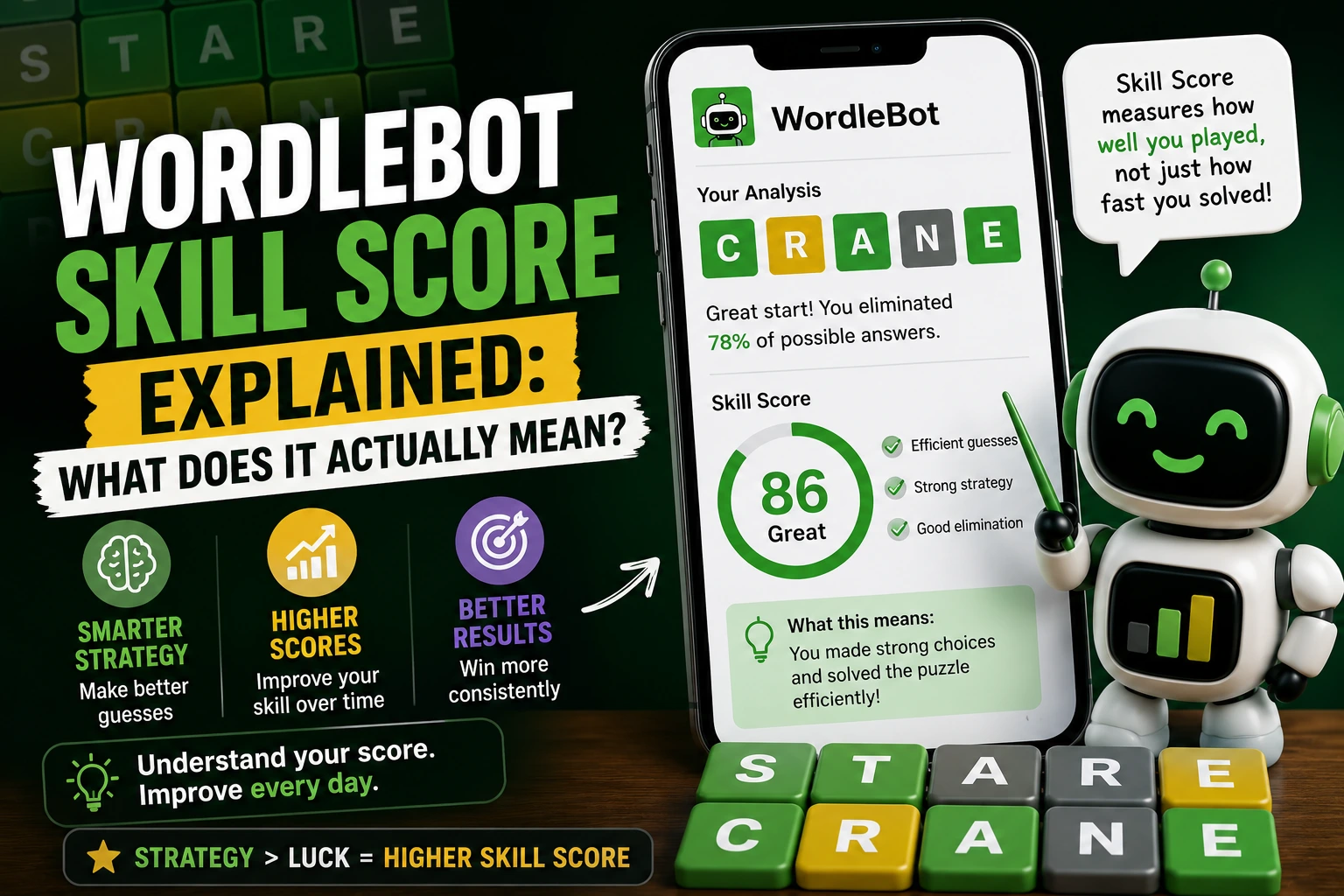
WordleBot Skill Score Explained: What Does It Actually Mean?
Ever finished a Wordle puzzle, checked WordleBot, and wondered why your Skill score seemed lower than expected? You’re definitely not the only one. Plenty of UK and US players solve the daily puzzle successfully but still feel confused by what the numbers actually mean.
That’s why wordlebot skill score explained has become such a popular topic among Wordle fans. Once you understand how the score is calculated, you’ll be able to spot stronger strategies, avoid common mistakes, and make smarter guesses in future games.
What is WordleBot Skill Score?
If you have ever reviewed a Wordle game using WordleBot, you have probably noticed two main ratings: Skill and Luck. While luck is easy to understand, the Skill score often leaves players wondering what exactly is being measured.
This is where wordlebot skill score explained becomes important. The Skill score is WordleBot’s way of evaluating the quality of your decisions throughout a puzzle. It does not simply reward you for solving the puzzle quickly. Instead, it measures how strategically you played based on the information available at each turn.
For example, two players might solve the same puzzle in four guesses. One player could receive a much higher Skill score because their guesses eliminated more possibilities and followed stronger logical patterns.
WordleBot evaluates factors such as:
- Choice of opening word
- Efficiency of each guess
- Information gained from every move
- Alternative words that may have performed better
This means the score focuses on decision making rather than just results.
Why WordleBot Skill Score Matters for Wordle Players
Many Wordle players focus only on whether they solved the puzzle in three, four, or five guesses. While that can be fun, it does not always reveal how well they actually played.
The Skill score provides a deeper look into your strategy.
Imagine solving a puzzle in three guesses because you got lucky. Compare that with another puzzle solved in four guesses using careful logic and strong elimination techniques. The second game may earn a higher Skill score because the decisions were objectively stronger.
This makes the feature valuable for players who want to improve over time.
Some benefits include:
- Understanding why certain guesses work better
- Learning efficient word selection
- Improving puzzle solving habits
- Tracking strategic growth
- Identifying recurring mistakes
The score acts like a coach reviewing your performance after every game.
Skill Score vs Puzzle Result
| Metric | What It Measures |
|---|---|
| Number of Guesses | How quickly you solved the puzzle |
| Luck Score | How fortunate your outcomes were |
| Skill Score | Quality of strategic decisions |
| Win Streak | Consecutive successful puzzles |
| Average Score | Long term puzzle results |
A high Skill score often leads to better results over time, even if a particular puzzle was challenging.
How to Understand and Improve Your Skill Score
Tip 1: Focus on Strong Opening Words
Your first guess has a significant impact on your overall Skill score.
Words such as CRANE, STARE, and SLATE are often viewed as strong starters because they combine common vowels with frequently used consonants.
Compare these examples:
| Starting Word | Strategic Value |
|---|---|
| CRANE | Very High |
| STARE | Very High |
| SLATE | High |
| AUDIO | Moderate |
| FUZZY | Low |
A word like AUDIO reveals several vowels but provides limited consonant coverage. By contrast, CRANE offers a balanced combination that helps eliminate more possibilities.
WordleBot generally rewards choices that maximize useful information early in the puzzle.
When reviewing your games, pay attention to how many possible answers remained after your opening guess.
Tip 2: Make Information Rich Guesses
One of the biggest misconceptions among Wordle players is that every guess should be an attempt to solve the puzzle immediately.
Strong players often think differently.
Instead of asking:
“What is the answer?”
They ask:
“What guess gives me the most information?”
Suppose your first word is STARE and you learn that A and R are present.
A weaker approach might be guessing a word with mostly repeated letters.
A stronger approach could involve testing several new letters to eliminate large groups of possibilities.
WordleBot values information gathering because it creates more efficient paths toward the solution.
This concept connects closely with LSI terms such as guess efficiency, letter elimination, and strategic word selection.
Tip 3: Learn From Better Alternatives
One of the most useful aspects of WordleBot is its ability to compare your choices against stronger options.
For example:
- CRANE
- HOUSE
- BRICK
- Solve
Although the puzzle is completed successfully, WordleBot may suggest that a different second guess would have reduced the answer pool more effectively.
When reviewing these suggestions, consider:
- What letters did the recommended word test?
- How many answers did it eliminate?
- Why was it statistically stronger?
- Would it have improved later guesses?
Over time, studying these recommendations helps build better instincts and stronger puzzle solving habits.
Players who consistently review their reports often see gradual improvements in both Skill scores and overall results.
Common Mistakes Players Make
Chasing the Answer Too Early
Many players become fixated on solving the puzzle after the first hint appears.
This often leads to guesses that provide very little new information.
WordleBot typically rewards moves that explore additional possibilities before committing to a final answer.
Misunderstanding What the Score Represents
A common mistake is assuming the Skill score reflects intelligence or vocabulary.
It does not.
The score measures decision quality within the puzzle. Even experienced players can receive lower scores if they make inefficient choices.
Ignoring Alternative Recommendations
Some players only check the final score and skip the detailed analysis.
The suggestions provided by WordleBot often contain the most valuable lessons.
Reviewing these recommendations helps identify opportunities for improvement.
Overvaluing Vowels
Words like AUDIO and ADIEU remain popular because they contain many vowels.
While vowels matter, WordleBot often favors balanced words that include common consonants such as R, S, T, N, and L.
Relying Too Heavily on Luck
A lucky guess can occasionally produce an excellent result.
However, strong Skill scores come from consistent strategic decisions rather than fortunate outcomes.
Focusing on process instead of luck usually leads to better long term performance.
Expert Tips for UK/US Players
Wordle players across the United Kingdom, United States, and Australia can improve their Skill scores by adopting a few practical habits.
Build a Consistent Opening Strategy
Rather than selecting a completely random word each day, choose a small group of proven starters.
Examples include:
- CRANE
- STARE
- SLATE
- TRACE
- LEAST
Consistency makes it easier to evaluate performance and refine your approach.
Study Letter Frequency
Many successful Wordle answers contain common letters such as:
- E
- A
- R
- T
- S
- N
- L
Prioritizing these letters early often improves both efficiency and Skill ratings.
Review Every Puzzle
The biggest improvements usually come from post game analysis.
Spend a few minutes examining:
- Your strongest guesses
- Your weakest guesses
- Better alternatives
- Remaining answer counts
These insights reveal patterns that may not be obvious during gameplay.
Think Like a Statistician
WordleBot evaluates probability and efficiency.
Instead of relying solely on intuition, consider which guess is most likely to reduce the answer pool significantly.
This approach aligns closely with how the scoring system works.
Track Trends Rather Than Individual Scores
One low Skill score does not mean much.
Focus on whether your average performance improves over several weeks.
Consistent growth is a far better indicator of progress than any single puzzle result.
Quick Skill Score Guide
| Skill Score Range | What It Usually Means |
|---|---|
| 90 to 99 | Excellent strategic play |
| 80 to 89 | Strong decision making |
| 70 to 79 | Solid performance with room to improve |
| 60 to 69 | Average strategy |
| Below 60 | Several inefficient guesses |
Understanding these ranges can help you interpret your results more effectively and identify realistic improvement goals.
Whether you are consistently solving Wordle in three guesses or still working toward more reliable results, understanding wordlebot skill score explained can give you a clearer picture of how well you’re actually playing.
The goal is not to chase a perfect number but to make smarter decisions and build stronger habits over time. Try this strategy tomorrow and see the difference. Open your most recent WordleBot report today and review one guess that could have been improved.


One Comment