
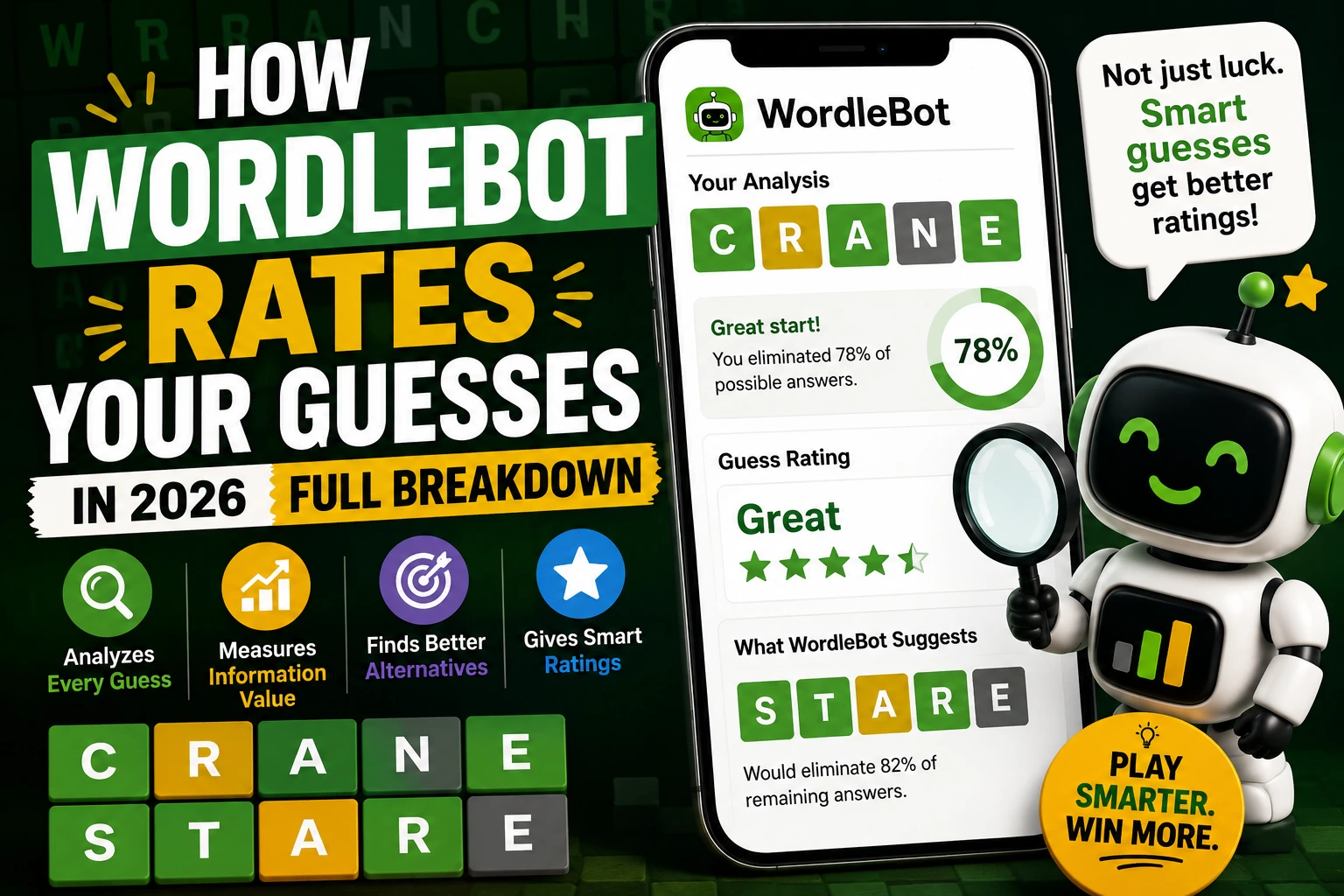
How WordleBot Rates Your Guesses in 2026 Full Breakdown
Ever looked at a WordleBot report and wondered why one guess earned praise while another got a surprisingly low rating?
You’re not alone. Plenty of UK and US players solve Wordle every day but still feel confused about what makes a guess “good” in the eyes of WordleBot. Understanding how wordlebot rates guesses can completely change the way you approach the game. Once you know what WordleBot is measuring, you’ll be able to make smarter choices, avoid common traps, and improve your results more consistently.
What is WordleBot Guess Rating?
If you have ever finished a Wordle puzzle and checked your WordleBot report, you may have noticed that not all guesses are treated equally. Some guesses earn praise, while others receive lower ratings even if they eventually helped solve the puzzle.
Understanding how wordlebot rates guesses can help players make better decisions and improve their overall performance. WordleBot is designed to evaluate the quality of each guess based on the information available at that specific moment in the game.
Rather than focusing only on whether you solved the puzzle, the tool examines how effectively each word narrowed the list of possible answers.
When rating a guess, WordleBot typically considers:
- Information gained from the word
- Number of remaining solutions eliminated
- Letter coverage and efficiency
- Alternative words that may have performed better
- Statistical strength of the choice
This makes WordleBot less concerned with luck and more interested in strategic decision making.
Why WordleBot Guess Ratings Matter for Wordle Players
Many players judge their success solely by the number of guesses used to solve a puzzle.
While solving in three guesses feels great, WordleBot takes a broader view. A quick solve does not always mean the strategy was optimal.
For example, a player might solve a puzzle in three guesses because of fortunate letter placements. Another player may solve it in four guesses while making stronger strategic choices throughout the game.
Guess ratings matter because they help players understand:
- Why some words perform better than others
- How information gathering improves results
- Which habits reduce efficiency
- How to develop stronger puzzle solving skills
- Ways to improve future Wordle games
The goal is not simply to solve puzzles but to solve them intelligently.
Guess Rating vs Puzzle Outcome
| Measurement | What It Evaluates |
|---|---|
| Number of Guesses | Speed of solving |
| Luck Score | Favorable outcomes |
| Guess Rating | Quality of individual guesses |
| Skill Score | Overall strategic performance |
| Win Streak | Consecutive successful games |
This distinction helps explain why a puzzle result and a guess rating do not always align.
How WordleBot Rates Your Guesses
Tip 1: It Measures Information Value
One of the biggest factors in WordleBot’s evaluation system is information value.
Every guess should reveal something useful about the puzzle.
Consider these opening words:
- CRANE
- STARE
- SLATE
- AUDIO
Although AUDIO contains several vowels, words like CRANE and STARE often provide more balanced information because they include frequently used consonants.
Imagine the answer is BRICK.
If you start with CRANE, WordleBot evaluates how effectively that guess reduced the number of possible answers.
The more information a word reveals, the higher its rating tends to be.
This is why strong Wordle players often prioritize information gathering over immediately trying to guess the answer.
Tip 2: It Evaluates Remaining Possibilities
After every guess, WordleBot calculates how many possible answers remain.
Suppose your first guess is STARE.
The puzzle confirms the presence of R while eliminating several other letters.
At that point, WordleBot asks:
“How effectively did this guess reduce the solution pool?”
A highly rated guess leaves very few possible answers behind.
A poorly rated guess may reveal some information but still leave hundreds of possibilities available.
This concept forms the foundation of efficient Wordle strategy.
The fewer possibilities remaining after each turn, the easier the puzzle becomes.
LSI concepts such as answer elimination, word efficiency, and puzzle analysis naturally fit into this evaluation process.
Tip 3: It Compares Your Choice Against Better Alternatives
Perhaps the most interesting part of the rating system is comparison analysis.
WordleBot examines whether another available word could have performed better.
For example:
- CRANE
- HOUSE
- PILOT
- Solve
You may solve the puzzle successfully, but WordleBot could suggest that another second guess would have reduced the answer pool more efficiently.
When reviewing your report, ask:
- Which alternative word was recommended?
- What letters did it test?
- How many possibilities would it have removed?
- Why did it outperform my choice?
These comparisons provide valuable lessons that help improve future games.
Over time, studying better alternatives strengthens pattern recognition and strategic thinking.
Common Mistakes Players Make
Choosing Familiar Words Instead of Efficient Words
Many players select guesses because they seem familiar or common.
WordleBot cares more about efficiency than familiarity.
A less obvious word may provide stronger information and receive a higher rating.
Repeating Confirmed Letters Too Often
Once certain letters are confirmed, some players repeatedly use them without testing enough new letters.
This slows down the elimination process and often results in lower guess ratings.
Strong guesses introduce fresh information whenever possible.
Ignoring Consonant Coverage
Vowel heavy words like AUDIO and ADIEU remain popular among casual players.
While vowels are important, WordleBot frequently rewards words that balance vowels with common consonants.
Letters such as R, S, T, N, and L often provide more valuable information early in the puzzle.
Chasing the Solution Too Quickly
Many players become focused on finding the answer immediately after discovering one or two correct letters.
WordleBot often favors guesses that collect additional information before committing to a final answer.
This strategy may seem slower initially but usually leads to more consistent results.
Focusing Only on Final Scores
A common mistake is paying attention only to Skill scores or solve counts.
The ratings for individual guesses often reveal the most useful insights.
Improvement comes from understanding each decision rather than simply looking at the final outcome.
Expert Tips for UK/US Players
Wordle players across the UK, USA, and Australia can improve their ratings significantly by following a few practical habits.
Use Proven Opening Words
Certain words consistently perform well because they contain common letters and balanced coverage.
Popular examples include:
- CRANE
- STARE
- SLATE
- TRACE
- LEAST
These words typically generate useful information from the first turn.
Think About Elimination First
Before entering a guess, ask yourself:
“How many possibilities could this word eliminate?”
This simple question aligns closely with how WordleBot evaluates performance.
Review Every WordleBot Report
The analysis provided after each game contains valuable insights.
Look at:
- Strongest guesses
- Weakest guesses
- Recommended alternatives
- Remaining answer counts
Small daily improvements accumulate quickly.
Learn Common Letter Frequencies
Many Wordle answers rely heavily on letters such as:
- E
- A
- R
- T
- S
- N
- L
Prioritizing these letters early often results in stronger ratings.
Focus on Process Over Luck
Lucky guesses occasionally produce great results.
However, WordleBot rewards consistent strategic thinking.
Players who focus on making strong decisions generally see their ratings improve over time regardless of short term outcomes.
Typical Guess Rating Characteristics
| Rating Quality | Common Traits |
|---|---|
| Excellent | Eliminates many possibilities and tests strong letters |
| Good | Provides useful information and narrows options |
| Average | Some value but limited efficiency |
| Weak | Reveals little information |
| Poor | Misses opportunities to reduce possibilities |
Understanding these characteristics can make it much easier to interpret WordleBot feedback and identify areas for improvement.
Whether you solve Wordle in three guesses or need all six attempts, understanding how wordlebot rates guesses can help you become a more strategic player over time. The real value is not in chasing perfect ratings but in learning why certain words provide better information than others. Try this strategy tomorrow and see the difference. After your next puzzle, review the lowest rated guess in your WordleBot report and identify one better alternative you could have played.


The content is really great
WOW,Very wonderful
That was amazing
The example chosen makes the point land well. It is easier to add than to remove, and planning around that helps. Donald Lee
The explanation here is more grounded than most treatments of the topic. Boundary cases are where this usually breaks, and the write-up says so plainly. That is a reasonable place to stop for a first pass.
Hi,how are you
Its Amazing