
Worldle Distance Clues: 8 Proven Ways to Read Them
Worldle distance clues are the numbers that appear after every wrong guess, and they are the heart of the daily geography puzzle. Each clue tells you how far your guess was from the mystery country in kilometers or miles, plus an arrow pointing the direction. This guide gives you 8 proven ways to read worldle distance clues and turn those numbers into fast correct answers.
Why Worldle Distance Clues Matter
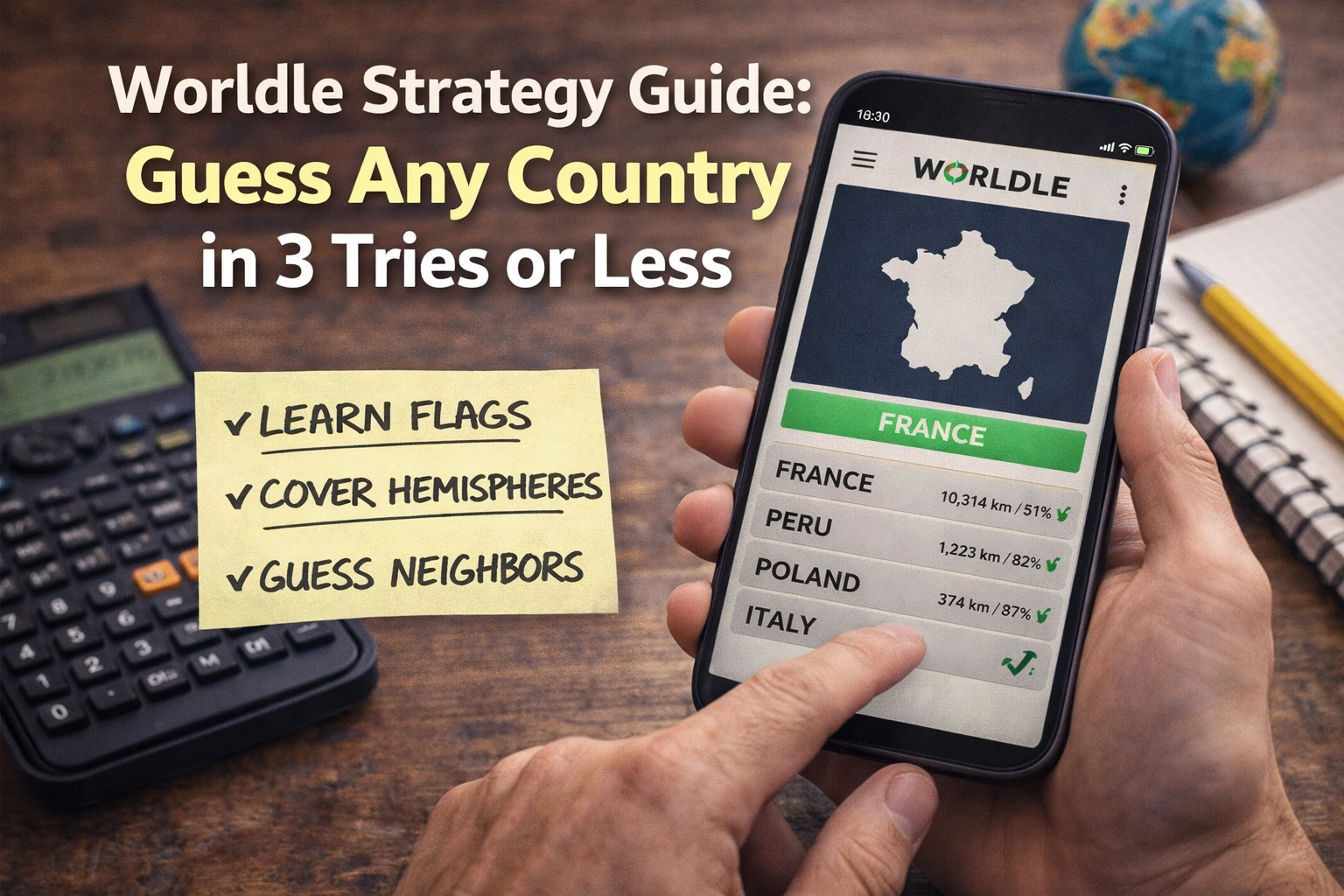
Every worldle distance clue is a measurement you can use. A guess that lands 8,000 kilometers away tells you the answer is on the other side of the planet, while a guess 400 kilometers away means you are already in the right neighborhood. The number alone eliminates most of the world.
Players who only look at the arrow and ignore the number waste half the clue. Distance plus direction together draw a circle on the map, and the answer sits somewhere on that circle. Learn to read both parts and your worldle distance clues become a precision tool. Start with our how to read Worldle clues pillar guide.
Way One: Learn What the Number Really Means
The distance in worldle distance clues is measured from the center of your guessed country to the center of the mystery country. It is not border to border, so neighboring countries can still show a few hundred kilometers. Knowing this stops you from ruling out close neighbors too early.
Memorize a few reference distances to calibrate your sense of scale. The Atlantic is about 5,000 kilometers wide, Europe fits inside 4,000 kilometers, and anything above 10,000 usually means the opposite side of the globe. With these anchors, every worldle distance clue becomes instantly meaningful.
Way Two: Read the Arrow With the Number
The arrow in worldle distance clues points from your guess toward the answer, not the other way around. An arrow pointing northeast means the mystery country sits northeast of your guess. Combine this with the distance and you get a target zone.
Draw the direction mentally on a globe, then step the stated distance along it. This two part reading is the core skill of the game, and it is exactly what our Worldle clues pillar teaches in detail. Practice it on every guess until it feels automatic.
Way Three: Use Big Distances to Switch Continents
When worldle distance clues show more than 8,000 kilometers, stop guessing nearby countries and jump continents. A huge number means your whole region is wrong, and small steps will only waste guesses.
Pick your next guess on the far side of the indicated direction. If you guessed in Europe and the clue says 9,000 kilometers southeast, try Southeast Asia or Australia next. Big jumps after big numbers are the fastest way to close the gap. Our Worldle 3 tries guide shows how bold openers win.
Way Four: Use Small Distances to Narrow the Region
When worldle distance clues drop under 1,000 kilometers, you are close, so switch from jumping to creeping. List the neighbors of your guess in the arrow direction and test them one by one. The answer is almost always within one or two borders.
Small numbers reward local geography knowledge, so study which countries touch each other. Island nations near a coast, small states inside larger regions, and border clusters are the usual answers when the distance shrinks. Patience here converts near misses into wins.
Way Five: Triangulate With Two Guesses
Two worldle distance clues from different starting points let you triangulate. Guess one country in the west and one in the east, then follow both arrows toward the overlap. The answer sits where the two direction lines meet at the stated distances.
This technique turns the puzzle into geometry instead of guessing. It works best when your two guesses are far apart, because wide angles give a tighter fix. Strong players plan triangulation pairs deliberately, as explained in our Worldle daily strategy guide.
Way Six: Watch for the Shrinking Pattern
Track how your worldle distance clues change from guess to guess. Distances that keep shrinking mean you are walking straight toward the answer, while a sudden jump up means you overshot it. The pattern of the numbers tells a story.
When the distance grows after a guess, go back toward your previous guess and search between the two points. Overshooting is common with small countries hiding next to big ones. Reading the trend keeps you from wandering in circles.
Way Seven: Combine Distance With Country Shape
The silhouette shown each day works together with worldle distance clues. Once the distance tells you the region, match the shape against the countries there. A long thin shape in Southeast Asia or a round shape in Africa narrows the field fast.
Study distinctive outlines, Italy boot, Chile ribbon, and Egypt rectangle are famous examples. Shape plus distance plus direction is a triple lock that solves most puzzles by guess three or four. Our guess countries faster guide builds this visual skill.
Way Eight: Drill Distances Until They Feel Natural
Like every geography skill, reading worldle distance clues improves with deliberate practice. After each game, look at your clue history and check whether your guesses followed the numbers logically. Note every time you ignored a big number and paid for it.
Replay past puzzles in practice mode and focus only on the distance numbers, forcing yourself to announce the region before guessing. This drill builds the calibration that separates casual players from daily winners. Try it on the official Worldle site today.
Frequently Asked Questions About Worldle Distance Clues
Are worldle distance clues exact? They are rounded to a sensible precision, so treat them as strong guidance rather than survey grade measurement. Does the game use kilometers or miles? You can switch units in the settings, and the numbers convert automatically.
Why did my distance barely change after a new guess? You probably moved sideways relative to the answer instead of toward it, so check the arrow again. Can the distance be zero? Only when you guess correctly, which ends the game. Play daily on the official Worldle site to keep improving.
Read Numbers and Win More
Worldle distance clues are the most honest feedback the game gives you, and this guide showed you 8 proven ways to use them. Learn the scale, read the arrow with the number, jump continents on big numbers, creep on small ones, and triangulate like a pro.
Start treating every distance as a direct order for your next guess, and your solve rate will climb fast. The numbers are already pointing at the answer, your job is to follow them. Then keep practicing with our Worldle practice mode guide.
Extra Worldle Distance Clues Habits
Once the basics feel natural, add habits that keep your worldle distance clues working hard. After each game, write down the clue sequence and whether your guesses obeyed it. Before each guess, say the distance and direction out loud.
Teach a friend to read the numbers, because explaining triangulation cements it forever. And track your average guesses per win each week to watch the trend improve. Small review habits turn good readers into great geographers.
Keep a small notebook of your best triangulation moments, because rereading your own wins builds confidence for the next hard puzzle. Over time your worldle distance clues reading will feel less like math homework and more like a sixth sense for geography, and that instinct is what daily winners rely on.


5 Comments