
How to Read Worldle Clues: Distance and Direction Arrows
Every Worldle round shows you a country silhouette and gives you six guesses to name it. After each wrong guess the game hands you worldle clues: a distance in kilometers, a direction arrow and a proximity percentage. Most players glance at these numbers and guess again on gut feeling. Learn to read them properly and you will triangulate the answer like a navigator.
Why Worldle Clues Confuse New Players
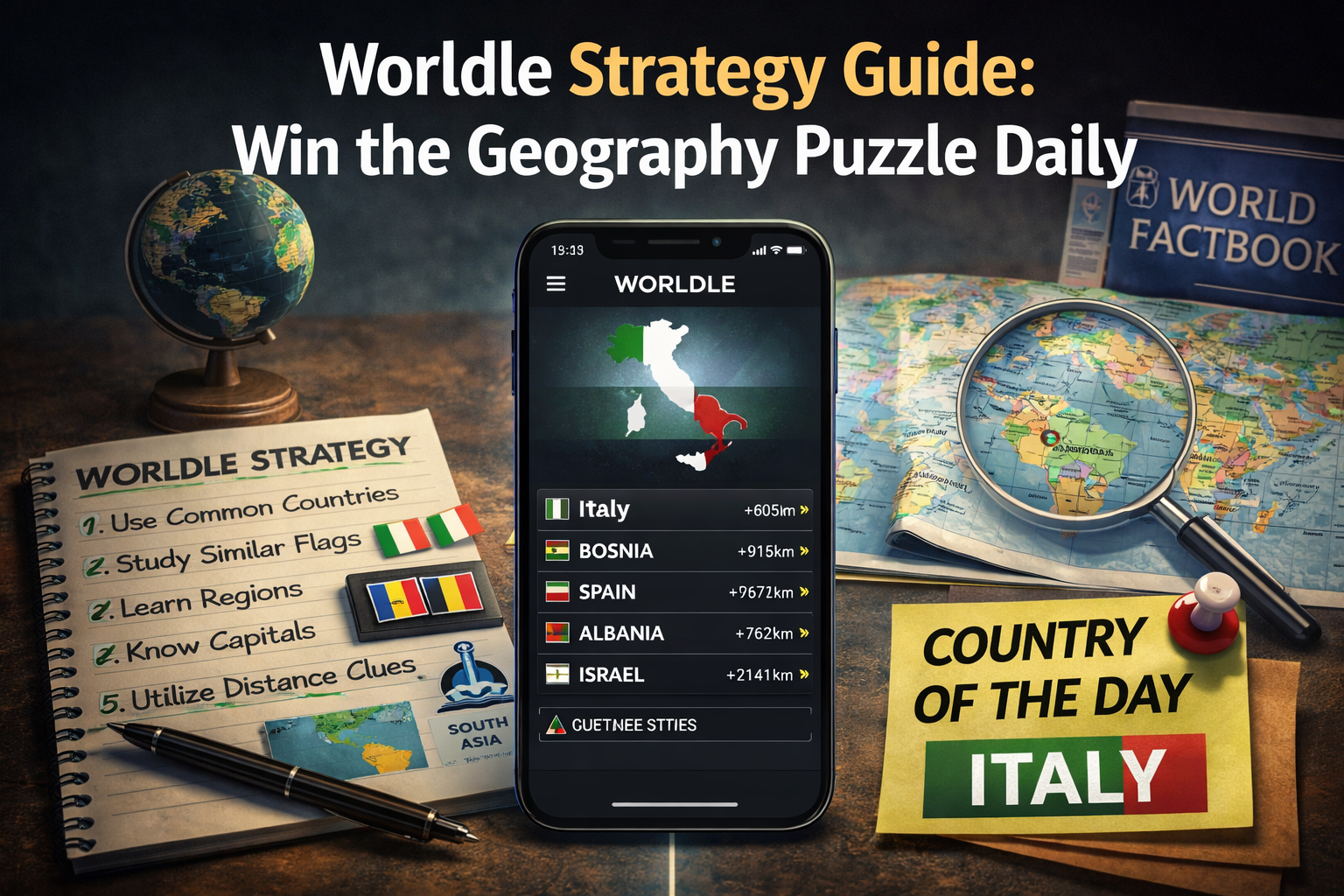
Worldle clues look simple, which is exactly why they mislead. New players see an arrow pointing right and a number like 4,200 km, then type the first country that pops into their head in that direction. The clues are always relative to your last guess, not to a fixed point on the map. Forget that fact and every distance number becomes meaningless. The second source of confusion is scale. Most people cannot picture 4,200 km, so they cannot tell whether it means close or far. Once you learn to anchor distances to countries you know, worldle clues turn from decoration into a precise navigation system.
Think of each guess as dropping a pin on the map. The game then tells you how far the treasure is from your pin and which way to walk. Your next pin should use both facts, not just one. Players who master this loop solve countries in three or four tries while everyone else burns all six.
What the Distance Number Really Means
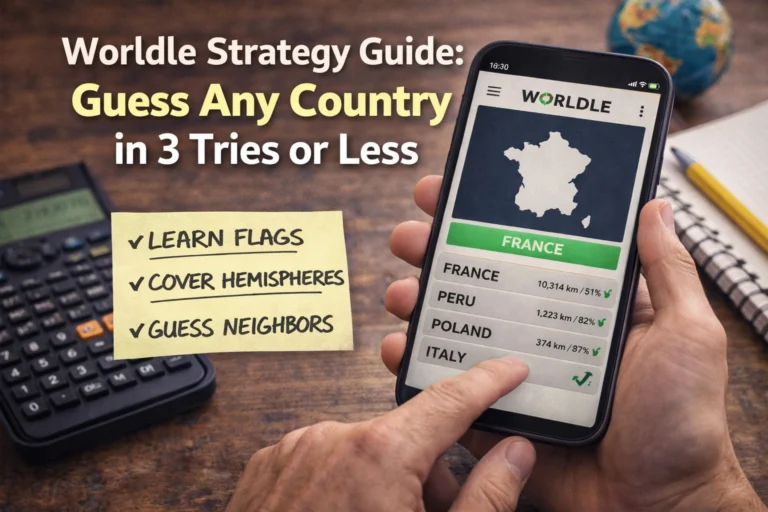
The kilometer figure measures the gap between the country you guessed and the mystery country, roughly center to center. A smaller number always means a warmer guess. The absolute value matters less than the trend. If your first guess shows 9,000 km and your second shows 4,500 km, you have cut the distance in half and you are moving the right way. If the number grows, you walked the wrong direction and should reverse course.
Build a mental scale from reference trips you know. The distance across the continental United States is roughly 4,500 km, and the Atlantic crossing from New York to London is about 5,500 km. When worldle clues show 1,000 km, you are looking at neighboring countries. When they show 12,000 km, the answer is on the other side of the planet. These anchors turn abstract numbers into useful geography.
How to Read Direction Arrows Like a Compass
The arrow always points from your guessed country toward the mystery country. Guess Japan and see an arrow pointing west, and the answer lies somewhere to the west of Japan. The game uses the eight main compass points, so read each arrow as north, northeast, east, southeast, south, southwest, west or northwest. Precision matters here. An arrow pointing northeast is very different from one pointing east, because at continental scale that 45 degree difference spans thousands of kilometers.
Combine the arrow with the distance before you type your next guess. An arrow pointing north with 2,000 km means something very different from the same arrow with 9,000 km. The first says the answer is a couple of countries away to the north. The second says it is a continent away. Players who read worldle clues as a pair, direction plus distance, rarely waste guesses on impossible candidates.
Clue Tactic 1: Start With Large Anchor Countries
Your first guess should be a huge country near the middle of a hemisphere, such as the United States, Brazil, Russia or Australia. Large countries give the cleanest clues because their centers sit far from most borders, so the distance number is stable and the arrow direction is unambiguous. A tiny first guess produces noisy clues, since a few hundred kilometers of error changes everything. Open big, then zoom in. These anchor guesses make every later set of worldle clues easier to interpret.
Clue Tactic 2: Use the Distance to Draw a Mental Circle
Take the kilometer number and picture a circle of that radius around your guessed country. The mystery country sits somewhere on that circle. Now look at the arrow, which cuts the circle down to one arc. Your next guess should be a country on that arc, roughly at the stated distance. This mental geometry is the heart of reading worldle clues well. You are not guessing countries, you are narrowing a ring.
Clue Tactic 3: Let Arrows Narrow the Hemisphere
Two arrows from two different guesses can eliminate half the planet. Guess a country in Europe and get an arrow pointing southeast, then guess a country in Africa and get an arrow pointing northeast. The answer must lie where those directions overlap. Each new arrow is a line on the map, and the target sits near their intersection. After three guesses you often know the region with high confidence, even if you have not named the country yet. Two good arrows are worth more than any single inspired guess, because worldle clues compound.
Clue Tactic 4: Combine Shrinking Distances for Triangulation
Triangulation is the endgame skill. When your distances read 6,000 km, then 3,000 km, then 1,200 km, you are walking straight at the target. Keep going in the same direction with neighboring countries. When a distance suddenly jumps back up, you overshot, so step back toward your previous guess. This systematic shrinking is far more reliable than inspiration. Trust the worldle clues over your gut and the best Worldle players look boring because they just follow the numbers home.
Common Mistakes When Reading Worldle Clues
The classic error is chasing the arrow while ignoring the distance. An arrow pointing east does not mean the next country east, it means the target is east at the stated distance, which could be ten countries away. Another frequent mistake is guessing island nations early, since their small size makes distance math jumpy. A third is forgetting that the silhouette itself is a clue. Match the shape to your candidate before you trust the numbers. The players who misread worldle clues usually misread them the same way every day, so check which of these habits is yours and fix it first.
A Practice Routine for Faster Country Guesses
Try this routine for one week. Play each round on the official Worldle game site and write down your distance and arrow after every guess before typing the next one. Forcing yourself to record the clues slows down impulsive guessing and reveals your patterns. Review your notes in our Worldle guides section and compare weeks. Most players cut a full guess off their average within days, simply by respecting the worldle clues.
Cross training helps too. The best Quordle starting words guide teaches information first thinking, avoiding common Nerdle mistakes builds discipline with feedback, and learning how to share Wordle results lets you compare scores with friends.
Frequently Asked Questions About Worldle Clues
What does the percentage next to the distance mean?
It is a proximity score. Higher means closer, with 100 percent meaning you found the country. Use it as a quick warmth check alongside the kilometer figure.
Does the arrow point from my guess or toward my guess?
It points from your guessed country toward the mystery country. Follow it forward, not backward.
How many guesses do I get in Worldle?
Six. That is why reading worldle clues efficiently matters, since every wasted guess is one sixth of your round.



23 Comments