Worldle Europe Countries: 8 Proven Ways to Win Them
Worldle Europe countries rounds look easy until a tiny Balkan shape or a Baltic outline steals your streak. Europe packs more than forty countries into a small area, and many of them share borders, coastlines, and similar sizes. This guide gives you 8 proven ways to win Worldle Europe countries rounds with calm region logic instead of blind guessing.
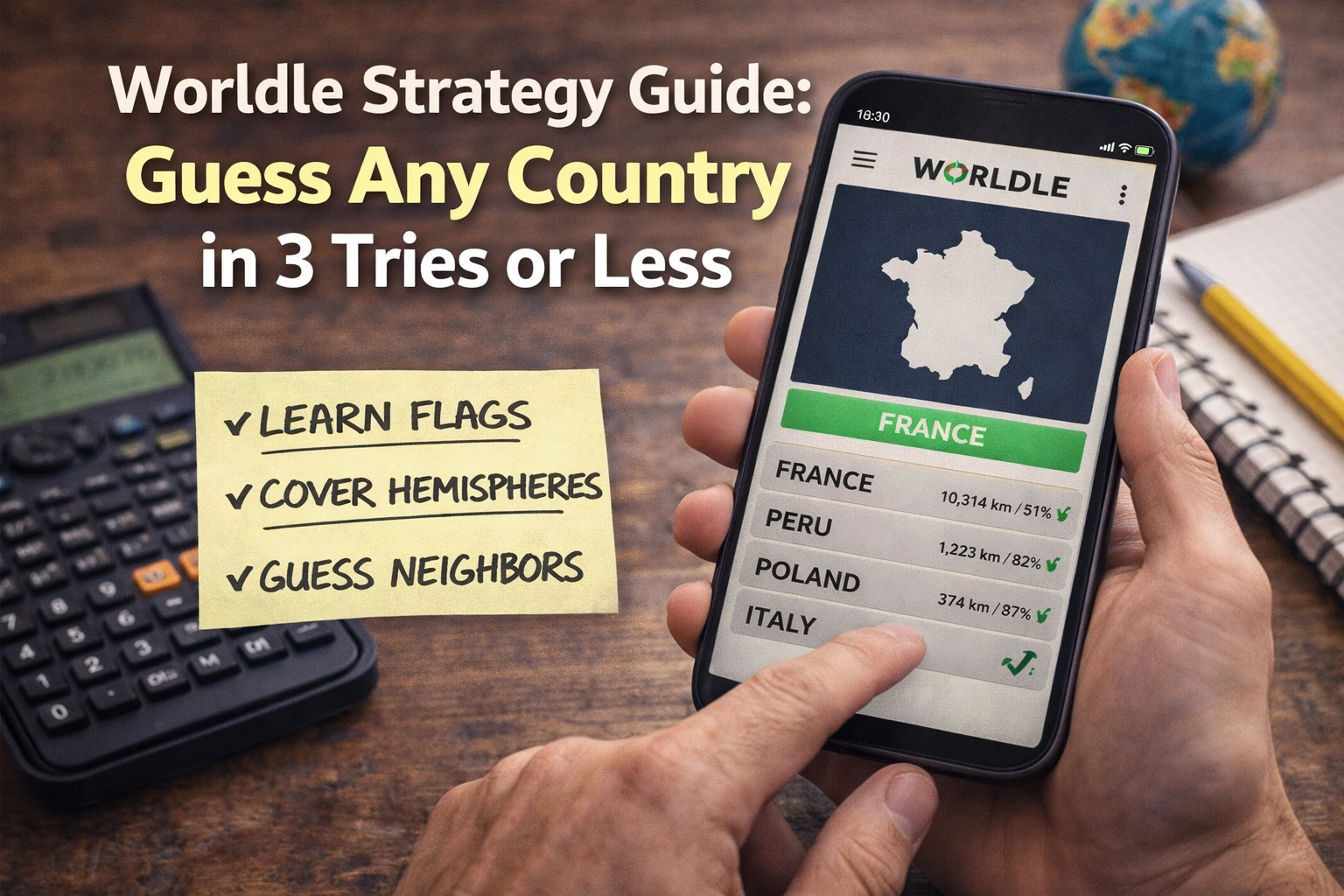
Why Worldle Europe Countries Trick Even Good Players
Europe feels familiar, and that familiarity is the trap. Players assume they know the map because they know France, Germany, Spain, and Italy. Then Worldle shows the outline of Montenegro, Latvia, or Moldova, and the confidence collapses. The continent is dense with small and mid sized countries, and the distance clues between neighbors are often only a few hundred kilometers apart. That is why Worldle Europe countries rounds punish casual knowledge. They reward players who study the crowded corners, not just the famous giants.
The good news is that Europe divides into clean regions with distinct visual styles. Western Europe holds the big familiar shapes. Scandinavia stretches tall in the north. The Balkans cluster tight in the southeast. Eastern Europe spreads wide with large landlocked states. The islands sit apart in the Atlantic and the Mediterranean. Once you learn these zones, Worldle Europe countries puzzles become a calm process of elimination. The eight ways below build that skill step by step.
Way One: Split Europe Into Four Regions
Before you drill any single country, split Europe into four zones in your mind. West, North, East, and South. Say them out loud and picture the borders between them. This single habit transforms Worldle Europe countries play because your first guess becomes a region probe. Guess a country from one zone, read the distance and arrow, and you instantly narrow the answer to a small part of the map.
Practice by naming four countries from each zone without looking. France, Germany, Netherlands, and Belgium for the west. Norway, Sweden, Finland, and Denmark for the north. Poland, Ukraine, Romania, and Hungary for the east. Spain, Italy, Greece, and Portugal for the south. When these groups come fast, your Worldle Europe countries rounds get faster too. A refresher on reading arrows sits in our Worldle clues pillar if you need it.
Way Two: Master the Big Western Shapes
Western Europe holds the shapes most players recognize, so master them first and use them as anchors. France has its famous hexagon with the Brittany point. Spain fills the Iberian Peninsula with Portugal tucked on its western edge. Germany sits central with a jagged northern coast. Italy is the unmistakable boot kicking Sicily. The United Kingdom is the large island off the northwest coast.
These giants make perfect first guesses in Worldle Europe countries rounds because they sit near the middle of the continent. A guess of Germany gives you useful distance readings for almost every other European answer. If the distance is small, the answer is a neighbor. If it is large, the answer sits on the far edge. Anchor your play on the giants and the map shrinks fast.
Way Three: Learn the Balkan Cluster
The Balkans are the hardest part of Worldle Europe countries play. Slovenia, Croatia, Bosnia and Herzegovina, Serbia, Montenegro, Albania, North Macedonia, Kosovo, and Bulgaria crowd into one small peninsula. Their shapes look alike, their distances blur together, and most players cannot name them all from memory.
Win this cluster by learning the coastal order first. Slovenia, Croatia, Bosnia and Herzegovina, Montenegro, and Albania line the Adriatic coast from north to south. Then learn the inland states: Serbia sits above North Macedonia, Bulgaria sits east of them all. When the arrow points southeast and the distance is small, walk the coast in your mind instead of guessing at random. Our country shapes guide drills these outlines in depth.
Way Four: Sort Scandinavia From the Baltics
Northern Europe confuses players because Scandinavia and the Baltic states sit close together but look very different. Norway is the long thin country along the western coast. Sweden is the wide mass to its east. Finland sits further east with its lake dotted shape. Denmark is the small peninsula and islands below them. Then come the Baltics: Estonia, Latvia, and Lithuania stacked in a neat vertical line.
Learn the Baltic order like a chant from north to south: Estonia, Latvia, Lithuania. Then learn what borders them. Finland sits above Estonia, Belarus and Poland sit below Lithuania. When a northern shape looks tall and thin, think Norway or Sweden. When it looks small and stacked, think Baltics. This clean split wins many Worldle Europe countries rounds in the north.
Way Five: Know the Island Nations
Europe has more island answers than players expect. The United Kingdom and Ireland sit in the northwest Atlantic. Iceland sits far north as a lonely island that is easy to spot once you know its shape. Malta and Cyprus sit in the Mediterranean as tiny dots that punish players who only study the mainland.
Add every European island nation to your study list. Learn that Iceland is northwest, the British Isles are west, and the Mediterranean islands are south. Our island nations guide covers these shapes in detail. When a Worldle Europe countries puzzle shows an island outline, you will name it fast instead of wasting guesses on mainland countries.
Way Six: Drill Eastern Europe Neighbors
Eastern Europe spreads wide with large countries that look similar at a glance. Poland, Ukraine, Belarus, Romania, Hungary, Slovakia, Czechia, and Moldova form a dense block where one wrong guess can send the arrow spinning. The key is to learn the neighbor chains instead of memorizing each outline alone.
Start with Poland and walk east: Poland, Ukraine, then the Black Sea. Walk south from Poland: Slovakia, Hungary, Romania. Learn that Belarus sits between Poland and Russia, and that Moldova is the small country between Romania and Ukraine. Our continent clues guide reinforces this regional thinking. Neighbor chains turn the east from a blur into a map you can read. This is core skill for Worldle Europe countries success.
Way Seven: Study the Microstates
Europe hides tiny microstates that shock unprepared players. Andorra sits in the Pyrenees between Spain and France. Liechtenstein sits between Switzerland and Austria. San Marino sits inside Italy. Vatican City sits inside Rome. Luxembourg is small but larger than the true microstates. Monaco clings to the French Riviera.
Learn each microstate by its host neighbor. If the shape is tiny and the distance from France or Spain is nearly zero, think Andorra. If it is tiny inside Italy, think San Marino or Vatican City. These answers are rare but they end streaks when players have no plan for them. A ten minute microstate drill makes your Worldle Europe countries defense complete.
Way Eight: Use the Iberian and Italian Peninsulas
The two great southern peninsulas are anchor zones every player should master. The Iberian Peninsula holds Spain and Portugal, with Andorra tucked in the Pyrenees at the top. The Italian Peninsula holds Italy with its boot shape, plus San Marino and Vatican City inside it. These zones are visually distinct and easy to learn.
Use them as southern probes. Guess Spain when the shape looks southwestern, guess Italy when it looks like a boot. The distance reading tells you whether the answer is on the peninsula or further east toward Greece and the Balkans. Open the official Worldle site and practice these two peninsulas until their outlines feel automatic. Southern confidence lifts your whole Worldle Europe countries game.
Frequently Asked Questions About Worldle Europe Countries
How many European countries can appear in Worldle? The game draws from the full country list, which includes more than forty European states plus microstates and island nations. Any of them can be the daily answer. What is the hardest European region in Worldle? Most players say the Balkans because of the crowded small states, followed by the Baltic and Eastern European clusters. Does Worldle include microstates? The full country list includes states like Andorra, Liechtenstein, San Marino, and Malta, so prepare for them.
Should I learn European capitals too? Capitals help as a backup clue, especially for the small states. Our capital cities guide covers that skill. How do I practice European shapes fast? Use the official Worldle site and guess European countries on purpose for a week. Ten focused minutes a day builds real map memory. Can region guessing really save guesses? Yes. A good region probe on guess one often cuts the candidate list from forty to fewer than ten.
Win Worldle Europe Countries With a Plan
Europe rewards the organized player. Split the continent into four zones, anchor on the western giants, learn the Balkan coast, separate Scandinavia from the Baltics, know the islands, chain the eastern neighbors, study the microstates, and master the two southern peninsulas. That is the complete plan. No single trick replaces it, but no round can resist it for long.
Start today with one zone and add another each day. Within a week your Worldle Europe countries results will look different. Fewer panicked guesses, more calm eliminations, and longer streaks. For faster general guessing, read our guide to guessing countries faster next.
Extra Worldle Europe Countries Habits
Keep a small notebook of the European countries you miss. Write the name, the zone, and the neighbor you confused it with. Review the list every Sunday. This five minute habit fixes your personal blind spots faster than any generic drill. Draw rough outlines from memory once a week. You do not need art skill. The act of drawing burns the shape into memory. Compare your sketch with the real map and note what you got wrong.
Play a weekly Europe only session where every guess must be a European country. This constraint forces you to use the zone logic under light pressure. Teach a friend the four zones. Explaining the map out loud reveals the gaps in your own knowledge. These small habits compound, and within a month Worldle Europe countries puzzles will feel like your strongest category instead of a coin flip.
More Worldle Europe Countries Study Ideas
Build flashcards with the country outline on one side and the name plus zone on the other. Shuffle them and name each outline in under five seconds. Time yourself on the four zone groups from Way One until you can name all sixteen countries in under a minute. Watch a geography quiz video and pause before each answer to guess first. Active recall beats passive watching every time.
Study the border chains for the tricky clusters. Learn which Balkan countries touch the sea and which are landlocked. Learn the exact north to south order of the Baltic states until it is automatic. Pair this article with our streak tips when your European rounds start extending your run instead of ending it. Steady study turns the densest continent into your biggest advantage.