
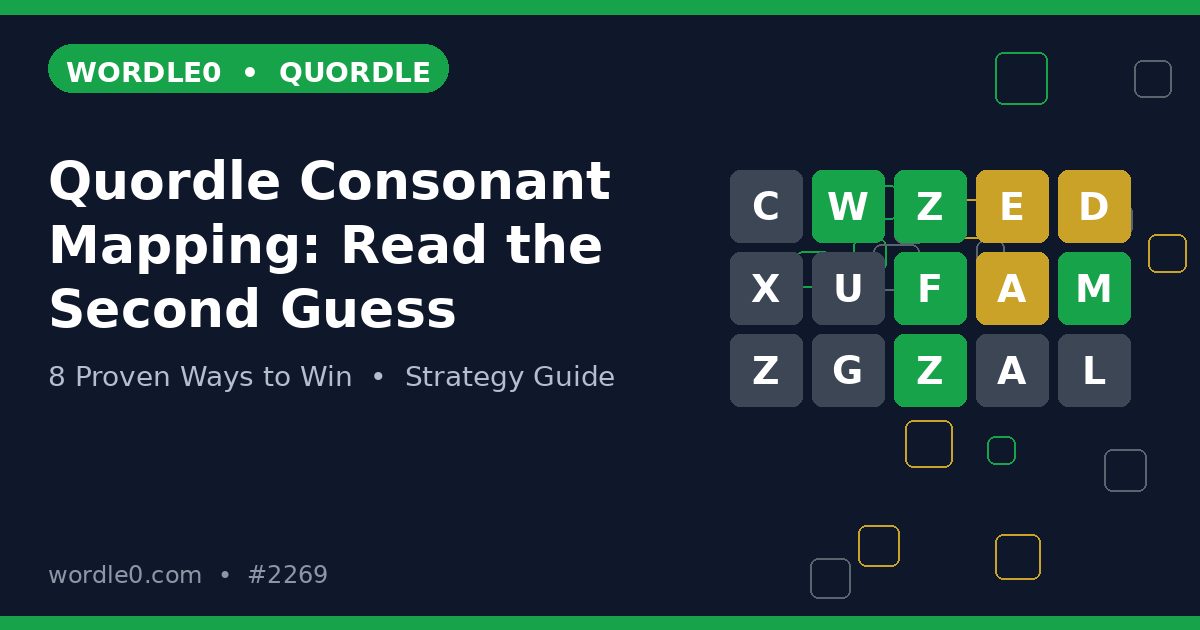
Quordle Consonant Mapping: Read the Second Guess
Your opener told you the vowels. Now what? Most players treat guess two as another random word, but the smartest Quordle players turn it into a consonant map that covers the remaining letters across all four grids. Learning quordle consonant mapping turns your second guess from a stab in the dark into a planned information strike.
This guide shows you how to build quordle consonant mapping into guess two and three, prioritize the letters that matter most, and read what the map reveals. When vowels give you the skeleton, consonant mapping gives you the rest of the word.

What Consonant Mapping Means in Quordle
Consonant mapping is the deliberate plan to test the highest value untested consonants in your early guesses. While the Quordle vowels first guide covers the vowel sweep, quordle consonant mapping handles the other half of the alphabet. Together they draw a complete map of every answer by guess three.
The map matters because consonants decide games. Two words can share every vowel and differ only in consonants, and without a mapping plan you burn guesses discovering R, T, N, S, and L one at a time.
The Priority Order: R, T, N, S, L, Then the Rest
Not all consonants are equal. In English five letter words, R, T, N, S, and L appear far more often than the rest, so quordle consonant mapping tests them first. Our Quordle letter frequency guide ranks the full order, but this five letter core covers the majority of answers.
After the core comes the second tier: C, D, P, M, B, G, F, and H. Rare letters like J, Q, X, and Z sit last, tested only when clues point at them. Mapping in priority order means every guess buys maximum information.
Building Guess Two as a Consonant Strike
Guess two should keep confirmed vowels, introduce zero repeated letters, and pack in priority consonants. If guess one was vowel heavy, guess two becomes the consonant strike: a word built from R, T, N, S, L plus any leftover vowels. Two guesses, nearly the whole high value alphabet covered.
Never waste guess two on a word that repeats guess one’s letters. The Quordle common mistakes guide flags repeated opener letters as one of the costliest early errors, and quordle consonant mapping exists to prevent exactly that.
Reading the Consonant Map: Green, Yellow, Gray
Green consonants anchor positions, just like the Quordle green letters guide teaches. Yellow consonants tell you the letter exists but sits elsewhere, which narrows its slot. Gray consonants eliminate letters across all four grids at once, and gray is often the most valuable result of all.
Read the map per grid, not globally. A consonant green in grid one and gray in grid two means different things in each place. Quordle consonant mapping is four small maps drawn from one shared set of guesses.
Blends and Pairs: Mapping Common Clusters
Consonants love company. Pairs like TH, CH, SH, ST, and TR, plus endings like CK and NG, appear constantly in five letter words. When quordle consonant mapping reveals a T and an H in the same grid, test them together as a cluster instead of separately.
Cluster thinking saves guesses. Guessing a word containing TH tests a two letter hypothesis in one slot, while separate tests cost two guesses. Watch for clusters in your yellow letters too, since the Quordle yellow letters guide shows how misplaced clues reveal pair positions.
When the Map Contradicts Your Instinct
Sometimes the map says a letter is gray everywhere but your gut insists it belongs. Trust the map. Quordle consonant mapping is data, and data beats instinct in a game of letters. Every time you override gray evidence with a hunch, you donate a guess.
The exception is the trap family, where the map leaves several candidates alive. There the Quordle trap words guide takes over with elimination guesses. Map first, then trap check, then solve.
Mapping Across Four Grids Without Losing Track
Four grids means four maps, and the shared guess budget means every mapping guess must serve all of them. Prioritize consonants that are still unknown in the most grids, and let the on screen keyboard be your notebook: untested letters are the remaining map to draw.
A practical routine: after each guess, scan the keyboard row and name three untested priority consonants. That thirty second habit keeps quordle consonant mapping active through the midgame instead of fading after guess two.
Common Consonant Mapping Mistakes to Avoid
The biggest mistake is testing rare consonants before the core five are mapped. The second is repeating a consonant to chase a double before singles are known, which the Quordle double letters guide warns against. The third is forgetting that gray letters are information, not failure.
Another error is mapping consonants while ignoring vowel feedback. The two halves work together: vowels give the skeleton, consonants give the flesh. A complete quordle consonant mapping plan never runs without its vowel partner.
Practice Drills for Mapping Speed
Drill one: after any game, list the consonants each of your first three guesses tested and count the repeats. Drill two: build a guess two word from any opener in under thirty seconds using only untested priority consonants. Run both on the official Quordle site, where practice mode makes repetition free.
Drill three: play a round where guesses one through three may not repeat any letter. That constraint forces real quordle consonant mapping and breaks the lazy habit of reusing comfortable words.
Frequently Asked Questions About Quordle Consonant Mapping
Should guess two always avoid repeating guess one’s letters? Almost always. Fresh letters buy fresh information, and the shared guess budget punishes repeats in the opening.
What if guess one already revealed several consonants? Then guess two pivots: keep the confirmed letters, and map the highest priority consonants that remain untested.
When should you test rare consonants like X or Z? Only when clues point at them, such as a confirmed pattern that fits few words. Blind rare letter tests waste the map.
Where can you practice consonant mapping? On the official Quordle site, practice mode lets you drill mapping guesses without risking your streak.
Build quordle consonant mapping into every game and your early guesses stop being guesses at all. They become measurements, and measurements win.
Review your last five games and score your second guesses on fresh letters. Count how many priority consonants each one tested, then notice the pattern: the games you won started with real quordle consonant mapping, and the games you lost started with repeats. The data is already in your history.
Make guess two sacred. No repeats, no hunches, no comfortable words. Build quordle consonant mapping into a routine so automatic that your second guess practically plays itself, and watch your midgame transform from scrambling into solving.
Start tomorrow’s daily with the mapping mindset: guess one draws the vowels, guess two draws the consonants, and guess three reads the map. When quordle consonant mapping becomes your default second guess, the rest of the game practically plays itself.
Tonight, open practice mode and play three rounds where your only goal is a perfect consonant map by guess three. No solving pressure, just mapping. That focused quordle consonant mapping drill will do more for your game than a week of casual dailies.



2 Comments