

Worldle First Guesses: 8 Proven Ways to Start Strong
Worldle first guesses set the tone for your entire game, and a smart opener is worth more than a lucky one. Most players start with a country they like, then waste two guesses wandering the map. Better players pick openers that give them the most information, so every later guess is a short step instead of a wild jump. This guide gives you 8 proven ways to plan worldle first guesses and turn your opening move into your biggest advantage.
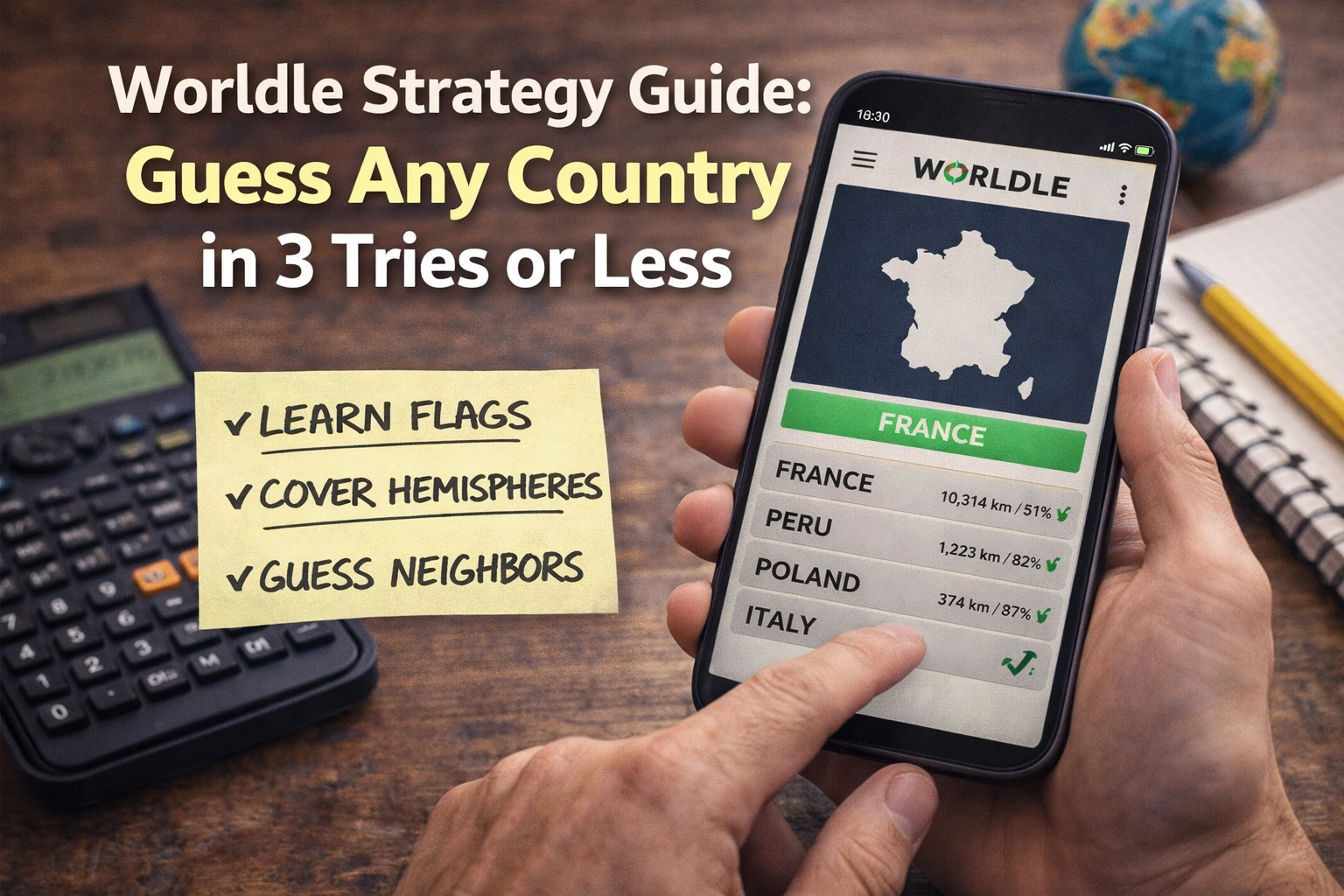
Why Worldle First Guesses Matter
Your first guess in Worldle is the only guess you make with zero information, so it has to work harder than any other. Every worldle first guess should split the globe into useful pieces, because the distance and arrow you get back are your only clues. A central opener divides the world cleanly, while an opener in a corner can send you on a 15,000 kilometer goose chase. Think of the opener as the foundation of the game: a shaky foundation means every later guess is a repair job. The how to read Worldle clues pillar guide explains exactly how to decode the numbers and arrows your opener returns.
Players who plan their openers solve faster because the clue points toward a known reference. When you guess a country you know well, you can read the distance against real geography instead of vague feelings. Weak worldle first guesses share one flaw: the player cannot place the country on a map with confidence. If you cannot picture its borders, you cannot use the clue it returns. So your opener must be a country you truly know, not just a name you have heard.
Way One: Open With a Country You Know Cold
The best worldle first guesses are countries you could find blindfolded on a map. Pick your home country if you know its geography, or a large country you have studied. When the distance comes back, you need to know exactly where your guess sits so the arrow means something. A famous opener strategy is France or Spain, because their position in western Europe divides the world nicely. Know the country first, and the clue second, and the game becomes a geography exercise instead of a guessing lottery.
Memorize the shape and neighbors of your chosen opener country. If your opener is Brazil, you should know it touches almost every South American country, so a small distance means a neighbor is likely. This familiarity turns worldle first guesses into calibrated instruments. Without it, even a perfect clue is just noise, because you cannot translate a number into a direction on land you do not know.
Way Two: Pick Central, Not Corner
Central countries make better worldle first guesses because they split the globe into balanced halves. An opener in the middle of the map means the answer can only be a few thousand kilometers away in the worst case. Corner openers like New Zealand or Alaska can return 15,000 kilometer distances that tell you almost nothing except to try the opposite side of the planet. The Worldle daily strategy guide shows how central openers shorten the average game.
Think of your opener as the center of a dartboard. The closer to the middle, the shorter every throw. Europe, the Middle East, and North Africa sit in the sweet spot for worldle first guesses, because they are near the center of the land masses. A guess from there divides Asia, Africa, and the Americas into readable zones. Corner guesses divide the world into one tiny zone and one giant zone, and the giant zone is where you will waste your guesses.
Way Three: Use the Same Opener Every Day
Consistency turns worldle first guesses into a measuring tool. When you open with the same country daily, you build an instinct for its distances to every region. You learn that Europe to East Asia is about 8,000 kilometers, that Europe to South America is about 9,000, and that nearby countries fall under 2,000. This calibration only comes from repetition. Rotate your opener and you reset your compass every single day.
Keep a small log of your opener results for a month and watch your instincts sharpen. Players who use one fixed opener for worldle first guesses report that they can guess the region from the distance alone, before even reading the arrow. That is the power of a consistent reference point. Your brain learns the map relative to one anchor, and every number becomes a familiar voice instead of a foreign language.
Way Four: Cover the Hemispheres With Your Opener
A strong worldle first guess sits where it can rule out a whole hemisphere. Guessing a country in southern Africa, for example, splits the north from the south cleanly. If the distance is huge, the answer is probably in the northern hemisphere, and you have just eliminated half the planet in one move. The Worldle 3 tries guide explains how bold early elimination wins games.
Study which opener countries give you the cleanest splits. An opener near the equator with a big distance tells you the answer is far north or far south, and the arrow names the direction. These hemisphere clearing worldle first guesses are the fastest way to shrink the search space. One guess, half the world gone, and your second guess can be a precision strike instead of another probe.
Way Five: Learn the Landmark Distances
Memorize a few landmark distances to read your worldle first guesses like a map. The Atlantic crossing from Europe to the Americas is about 5,000 to 6,000 kilometers. Europe to East Asia is about 8,000. The diameter of Africa is about 7,000. With these anchors, a 3,000 kilometer clue means nearby, a 10,000 kilometer clue means the far side of the planet, and a 500 kilometer clue means a neighbor. No more squinting at numbers.
Build your own reference list from countries you know. Pick five countries you could find instantly and learn the distances between them. This personal atlas makes every worldle first guess readable, because each clue lands on a scale you already feel. Players who do this drill solve in fewer guesses within weeks, because the numbers stop being abstract and start being geography.
Way Six: Never Open With a Tiny Country
Small countries make poor worldle first guesses because they cluster with neighbors you cannot tell apart. Guess San Marino and a 200 kilometer clue could mean Italy, France, or Switzerland, and you have learned almost nothing. Large countries give you clean, readable clues because their centers sit far from everything except their true neighbors. Size matters for openers.
The exception proves the rule: tiny countries are fine as second or third guesses, once the region is known. But worldle first guesses need room to breathe. Open with a big country, read the big distance, then zoom in with small ones. This big to small progression is the fastest path through the game, and it starts with an opener that has real geographic weight.
Way Seven: Practice Openers in Practice Mode
Run your planned worldle first guesses through practice mode before trusting them in the daily. Play ten rounds opening with the same country and watch how the clues behave. You will discover which regions your opener reads well and where it goes blind. The Worldle practice mode guide shows how unlimited rounds build opener instincts fast.
Try two or three candidate openers side by side and compare their average solve counts. This experiment takes an hour and pays off for months, because your opener is the most repeated decision you make in the game. Players who test their worldle first guesses in practice mode stop blaming bad luck and start trusting a proven opener. Try your system today on the official Worldle site and see the difference.
Way Eight: Adjust Your Opener After a Month
Your best worldle first guess today may not be your best one next month. After thirty days with one opener, review your games and ask where it failed. Maybe it struggles with Pacific islands or central Asia. If a pattern of weakness appears, switch to an opener that covers your blind spot. The game rewards players who adapt, not players who marry one country forever.
Keep the old opener as your backup plan for variety days. Many strong players keep two worldle first guesses: a default and a specialist for tricky regions. Reviewing monthly keeps your strategy fresh without the chaos of daily switching. Small, deliberate adjustments beat both stubbornness and randomness, and your stats will show it.
Frequently Asked Questions About Worldle First Guesses
Should worldle first guesses always be the same country? For most players, yes, because consistency builds calibration. Once you can read distances from your opener by instinct, you can experiment with a second opener for variety.
What is the single best opener country? There is no universal answer, but large central countries you know well work best. Pick one near the middle of the land masses that you could place on a map instantly, and test it in practice mode.
How do I know my opener is working? Track your average guesses over two weeks. If most games end in three or four guesses, your worldle first guesses are doing their job. If you keep burning five or six, try a more central opener. Keep practicing on the official Worldle site to keep improving.
Start Strong and Win More
Worldle first guesses are the highest leverage move in the game, and this guide showed you 8 proven ways to plan them. Open with a country you know cold, keep it central, stay consistent, and practice until the distances feel like a second language. Small opener upgrades compound into dramatically faster solves. Read the guess countries faster guide next to sharpen your follow up guesses too.
Your next daily is your next experiment, so pick your opener tonight and commit to it for a month. Track the results, adjust once, and watch your average drop. The players who solve in three guesses are not luckier, they just start smarter. And for reading the clues your opener returns, the Worldle distance clues guide is your perfect companion.
Extra Worldle First Guesses Habits
Once your opener is locked in, add habits that keep your worldle first guesses sharp. Say the country name out loud before tapping it, because the tiny pause catches misclicks. Glance at the silhouette first, since a distinctive shape can confirm or override your opener plan. And never change your opener mid game out of frustration, because the calibration you built is worth more than one lucky alternative.
Teach your opener strategy to a friend, because explaining the hemisphere split cements it in your own mind. Keep a note of your best opener reads, the times a single number told you the exact region, and reread them when your confidence dips. Great worldle first guesses are a skill, and skills grow with deliberate, joyful repetition.


10 Comments