

Worldle Opening Strategies: 8 Proven Ways to Plan Guess One
Worldle opening strategies turn guess one from a lucky stab into the most useful guess of your game. Most players type the first country that pops into their head, then scramble to recover for the rest of the round. Players with a plan do the opposite: they choose an opener that buys maximum information, read the first clues calmly, and let guess two and three do the heavy lifting. A smart opening does not need a lucky first hit. It needs a method that works on the easy countries and the tricky ones, day after day.
This guide gives you 8 proven ways to build worldle opening strategies that set up every game for a fast solve. You will learn how to pick openers, what the first clues really tell you, and how to connect guess one to guess two without wasting a guess. With a real plan, your first guess becomes the foundation of a streak instead of a gamble. That is the promise of strong worldle opening strategies.
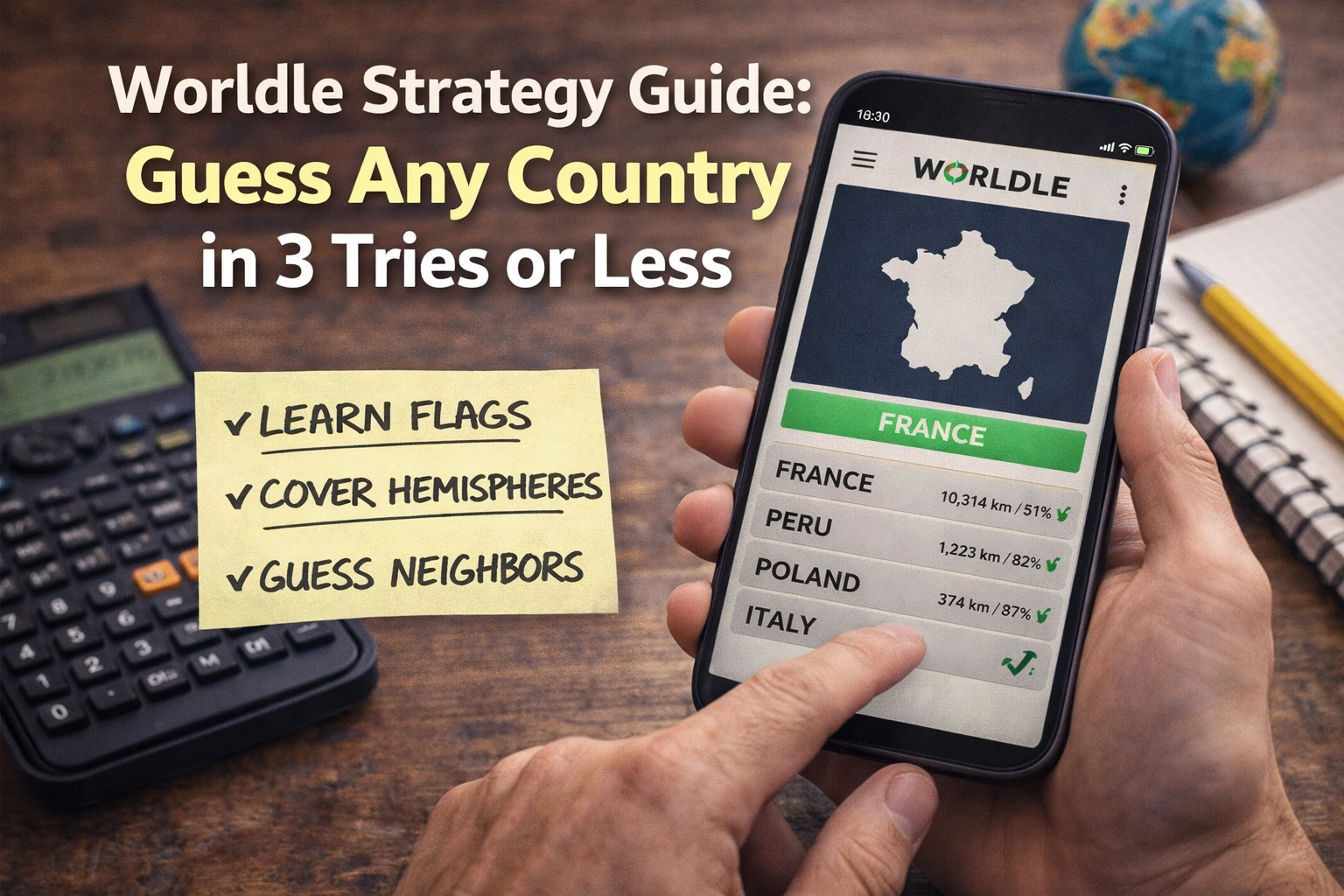
Why Worldle Opening Strategies Matter
Guess one is the only guess where you have zero clues, which makes it the cheapest place to experiment and the most expensive place to be careless. A thoughtless opener tells you almost nothing, so your next guesses start from the same blank map. A planned opener tells you a continent, a rough region, and sometimes a size, which turns guess two into a real investigation. The difference between those two starts is the difference between solving in four guesses and sweating at guess six.
Good worldle opening strategies also protect your mindset. A lucky opening hit feels great, but it teaches you nothing about reading clues. A methodical opening builds skills that carry through the whole week. Even when your opener is completely wrong about the target, it pays you in information you can use on guess two. That is the core idea: every opening should buy data, not chase a one in two hundred miracle.
Way One: Pick One Fixed Opener and Stick With It
The simplest of all worldle opening strategies is to stop choosing and start repeating. Pick one large, well placed country as your opener and use it every single day. Your fixed opener becomes a measuring stick: because you know exactly what its clues mean, you can read the first result in seconds. Players who rotate their opener randomly are relearning the map every day, while you are already moving.
Choose a big country in a central spot, somewhere that splits the globe cleanly so the distance and arrow clues cut the map in half. Our Worldle first guesses guide shows openers that buy maximum information on guess one. Once your fixed opener is in place, you will notice that guess two starts writing itself, because the same clue pattern appears again and again. Consistency is the fastest teacher in this game, and steady worldle opening strategies reward that patience.
Way Two: Open for the Continent, Not the Country
Do not try to guess the target on guess one. Try to guess the continent. That single change in thinking fixes most bad openings, because a guess aimed at a region is almost never wasted. Pick an opener whose clues tell you clearly whether the target is in the Americas, Europe, Africa, or Asia. Once you know the continent, five sixths of the wrong answers disappear.
This is one of those worldle opening strategies that feels slow but is actually fast. A continent first opening costs one guess and saves two, because every guess after it works inside a much smaller search area. Our Worldle continent clues guide helps you read which region the clues point to. Say it out loud after guess one: name the continent, then build guess two inside it. Your results will tighten up within a week.
Way Three: Buy the Arrow on Guess One
The direction arrow is the cheapest clue in Worldle, and the best worldle opening strategies collect it immediately. On guess one, make sure your opener is far enough from everywhere that the arrow points clearly. A muddled arrow helps nobody; a crisp arrow that says southwest or northeast cuts your search area in half before you have even thought hard.
After the arrow arrives, trust it completely and let it steer guess two. Many players read the arrow, then ignore it because they like a different idea, which throws away the information they just paid for. Our Worldle direction arrows guide shows how to combine the arrow with the distance number. Read the arrow first, the number second, and let both of them choose your next guess as part of your worldle opening strategies. Guess one buys the map; guess two walks it.
Way Four: Plan Guess Two Before You Play
Here is a secret of strong worldle opening strategies: the best players know their guess two before they even open the game. They have a small set of follow up countries ready for each type of guess one result. If guess one points east, guess two goes east. If guess one points to a big region, guess two picks a country inside it. No hemming, no guessing about guessing.
Build this habit in practice play, where nothing is on the line. Our Worldle practice mode guide gives you unlimited rounds to rehearse the opener to follow up sequence. Run ten practice games with the same opening and watch your follow up guesses get sharper. When you bring that routine to the daily game, your opening stops being a guess and starts being a system. Two planned guesses beat six random ones every time.
Way Five: Read the First Distance Number Like a Price Tag
The distance number on guess one tells you how big your mistake was, and smart worldle opening strategies use that number to size the next move. A huge distance means you are on the wrong side of the planet, so guess two should jump far. A medium distance means you are in the right half, so guess two should step into the arrow’s direction. A small distance means you are close, so guess two should test neighbors.
Most players glance at the number and move on, which wastes the clearest clue they have. Our Worldle distance clues guide teaches you to trust the numbers the first time. Tie the number to your follow up size: big miss, big move; small miss, small move. This habit alone turns random hopping into a guided search. Your opener and your follow up become partners instead of strangers when worldle opening strategies connect them.
Way Six: Never Spend Guess Two on the Same Idea
If guess one said the target is not in western Europe, do not spend guess two double checking western Europe. Repeating a ruled out idea is the most common way a good opening goes bad. Strong worldle opening strategies treat every clue as a locked door: once the door is shut, you move to the next room. Your guesses are too few to spend on countries that the clues already eliminated.
This discipline matters most right after a confusing opener, when the temptation to retest is highest. Our Worldle common mistakes guide shows how repeated ideas quietly eat your guess budget. Write down what guess one eliminated, then pick guess two from what is left. An opening only works if you believe its results, so honor the data and keep moving forward.
Way Seven: Keep the Streak Safe With a Sensible Opener
On days when your streak is on the line, the bravest of all worldle opening strategies is the boring one. A steady, well tested opener protects a long run better than a clever gamble. Save the creative openings for practice play and bring your most reliable opener to the daily game when the pressure is high. Streaks are built on routines, not on heroics.
This is also the day to slow down after guess one and read every clue twice before typing guess two. Our Worldle streak tips guide covers guarding a run with calm play. A sensible opener plus a careful follow up is how streaks reach fifty and beyond. The opening does not need to be brilliant on streak days. It needs to be dependable.
Way Eight: Review Your Openers Every Week
Worldle opening strategies are not set and forget, because you get better and your habits drift. Once a week, look back at your last seven openers and ask one question: which openers bought the most useful clues? Keep the winners, replace the losers, and adjust your fixed opener if a better one appears. A weekly review keeps your opening honest and stops bad habits from settling in.
Track your solve rate and your average guesses on the days you change your opener versus the days you keep it. Our Worldle results analysis guide gives you a simple review template. Most players discover that their fanciest openings score worse than their simplest one. Let the data pick your opener, and your worldle opening strategies will keep improving long after this guide.
Frequently Asked Questions About Worldle Opening Strategies
Should I change my opener every day?
No. A fixed opener beats a rotating one, because you learn to read its clues instantly. Change it only after a weekly review shows it is underperforming.
Is it bad to guess a country I already know is wrong?
Not always. A deliberate probe guess that tests a whole region can be smart, but a random guess at a known wrong country is wasted. Know the difference before you type it.
What if my opener accidentally solves it?
Enjoy it, then ignore it. One lucky hit is not a strategy. Keep using your planned opener, because its job is information, not miracles.
How do opening strategies connect to the guess budget?
Your opener is the first coin you spend, so it should buy the most information. Our Worldle guess budget guide shows how to price every guess, starting with guess one.
Plan Guess One Like a Pro
Tomorrow, open the game with a fixed opener, name the continent after the first clues, and pick guess two from a plan you made before the game. That small routine is the heart of every strategy in this guide. Your first guess will finally do real work, and your solves will get faster without getting riskier.
Extra Worldle Opening Strategies Habits
Keep a short list of three follow up countries for each compass direction, so guess two is never a scramble. Study a world map for five minutes a week and notice which countries sit in the middle of each region. Play a practice round with a brand new opener when you want to experiment, so the daily game keeps your best one. Small habits like these turn opening theory into muscle memory, and muscle memory is what wins on tired mornings. Keep sharpening your worldle opening strategies and the toughest boards will feel routine.
More Worldle Opening Strategies Study Ideas
Deepen your openings with our Worldle clues pillar and practice your follow ups on the official Worldle site until the sequence feels automatic. Try a week where you use the same opener every day and log the results, then compare it with a week of rotating openers. Test a continent first opening for five straight games and watch your average guesses fall. With worldle opening strategies as your foundation, every game starts with a plan instead of a prayer.


One Comment