

Connections Game Tips: Spot Groups and Dodge Traps
These connections game tips will help you spot groups fast and dodge the traps that end most runs. Connections shows sixteen words in a grid and asks you to sort them into four groups of four, each tied to a shared theme. You get four mistakes before the game ends, so every guess counts.
This guide collects the connections game tips that strong players use every day. You will learn how the four color levels work, why the puzzle plants decoys, how to test a group before you commit, and how to use elimination when the board gets thin. Follow this plan and you will solve more often with fewer mistakes.
How Connections Works: Groups, Levels, and Lives
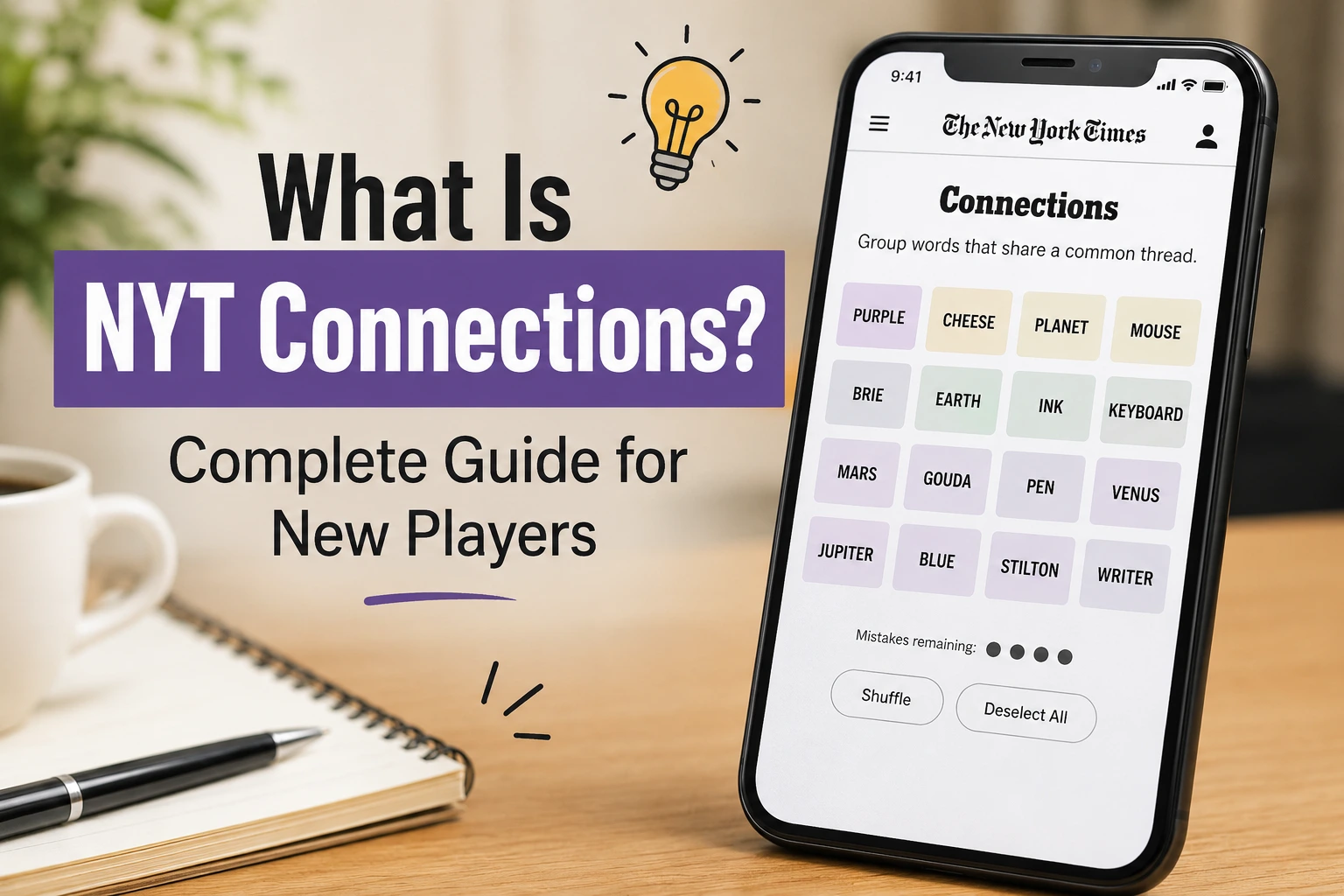
The board holds sixteen words. The editor groups them into four hidden sets of four, ranked by difficulty from yellow, the easiest, through green and blue, to purple, the hardest. Tap four words you believe belong together and submit. If the group is correct, the tiles lock in and show their color. If not, you lose one of four lives, and the game ends at zero.
Understanding this structure is the first of the connections game tips that matters, because your whole approach changes once you see the board as four difficulty levels instead of sixteen random words. Easy groups hide in plain sight. Hard groups hide behind wordplay. You can play the official Connections game daily to feel how these levels differ in practice.
Start With the Obvious Group
Look for the group that jumps out in the first ten seconds. Sports teams, colors, numbers, and common phrases often form the yellow or green set. Solving one group early shrinks the board from sixteen words to twelve, which removes half the noise and makes the remaining connections game tips much easier to apply.
One of the most reliable connections game tips is simply this: bank the easy win first, then think harder. A solved group also reveals its color, which tells you the difficulty of what remains. If yellow is gone, expect the rest to need sharper thinking.
Learn the Four Color Levels
Yellow groups are usually simple categories: types of trees, kitchen tools, or sports. Green and blue groups need a little more thought: words that follow the same word, homophones, or members of a set. Purple is the tricky one. It often hides wordplay: words that share a letter pattern, words that can precede the same word, or words that look alike.
When you study the solved groups in your past games, as our NYT Connections strategy guide suggests, you start to recognize the purple style. Players who learn the color levels spend less time chasing yellow ideas in the purple zone, which is where most late game mistakes happen.
Red Herrings: How Traps Are Built
Editors plant decoys on purpose. Five words may fit a tempting category while only four belong, which is the classic trap. Another trick is a word with two meanings where the obvious meaning is wrong. A third is a near group: three words that fit beautifully plus one that looks right but is not.
Spotting these traps is the heart of good connections game tips, because most losses come from rushing a near group instead of checking the fifth suspect. When a group feels almost too easy, pause and hunt for the extra word that fits the same theme. If you find it, your group is wrong.
Shuffle the Board to See Fresh Links
Word position lies to you. When four words sit in a row, your brain invents a link. Hit shuffle to break those false patterns and see the words with fresh eyes. Many players find that a group hides in plain sight after two or three shuffles.
Make shuffling one of your standing connections game tips. Shuffle before every guess, especially after a mistake, when frustration narrows your thinking. The best players treat shuffle as a reset button for their eyes, not as a last resort.
Test Suspects Before You Submit
Before you submit any group, run two checks. First, ask whether a fifth word could fit the same theme. If it can, your group is probably wrong or incomplete. Second, ask what the other three words would be if you removed your weakest pick. If you cannot answer, slow down.
The game even warns you when you are one away, which is a free hint: it means three of your four are right, so only change one word. These patient connections game tips save lives, in the most literal sense of the game.
Say the Connection Out Loud
Vague groups fail. If your theme is things that are cold, demand the exact link before you tap submit. Name the category in words: words that come before house, or types of pasta. If you cannot state the connection clearly, you do not have one.
Speaking it out loud also catches the double meaning trap, where the word you picked works only under a meaning that does not fit the other three. Play daily on the official Connections game and narrate your reasoning on each board until precise naming becomes a habit.
Use Process of Elimination Late in the Game
With eight words left and two groups to find, stop hunting and start eliminating. List the words you are sure about and build around them. If one word can only fit a single theme, lock that theme in.
Late game connections game tips are all about certainty. Submit the group you know, then solve the last four by default. The final group is free once the other three are found, so protect your last life for the hard one. Players who enjoy sorting puzzles also improve quickly with our Octordle tips on scanning and triage, since both games reward systematic board reading.
Build Your Category Vocabulary
Strong players study category types. Common families include words before or after a shared word, homophones, things with the same shape, movie or book titles, sports terms, and members of a famous list. Reviewing past puzzles teaches you the editor’s favorite patterns, and each pattern you learn makes the next board faster.
Keep a simple note on your phone with categories you have seen. After a month of play, that note becomes a personal cheat sheet, and these connections game tips compound into genuine skill. The editors reuse ideas more often than you would expect.
Frequently Asked Questions About Connections Game Tips
How many mistakes can I make in Connections?
Four. The game ends after your fourth wrong guess, so these connections game tips focus on testing groups before you submit.
What do the colors mean?
Yellow is the easiest group, then green, then blue, with purple the hardest. The colors only reveal after you solve a group.
What does one away mean?
Three of your four words are correct. Change exactly one word instead of scrapping the whole guess.
Where can I play Connections?
Play the daily puzzle on the official game page, and practice calm multi puzzle thinking with our Quordle tips. The patience you build in one game carries into the other.
One more of the underrated connections game tips is to screenshot the solved board and study the purple group for a full minute. Ask yourself what signal you missed and where the decoys sat. That short review teaches you the editor’s habits faster than any other habit.
Finally, remember that Connections rewards precision over speed. Four careful guesses beat eight rushed ones every time. Use these connections game tips daily, protect your four lives like they are precious, and the purple group will stop feeling impossible.




8 Comments