
NYT Connections Strategy: Find Groups and Avoid Traps
NYT Connections looks simple: sixteen words, four groups, one daily puzzle. Yet most players lose more often than they win, because the game is designed to mislead you. A solid connections strategy turns the puzzle from a guessing game into a logic exercise. This guide teaches you how to find real groups fast, spot the red herrings the editors plant, and protect your four mistakes so you finish every board.
Connections rewards careful reading more than broad knowledge. You do not need a huge vocabulary. You need a method for testing ideas before you submit them, a habit of looking for the trick in every board, and the patience to wait for certainty. Build those habits and your solve rate will rise within days.
How NYT Connections Works in Plain English
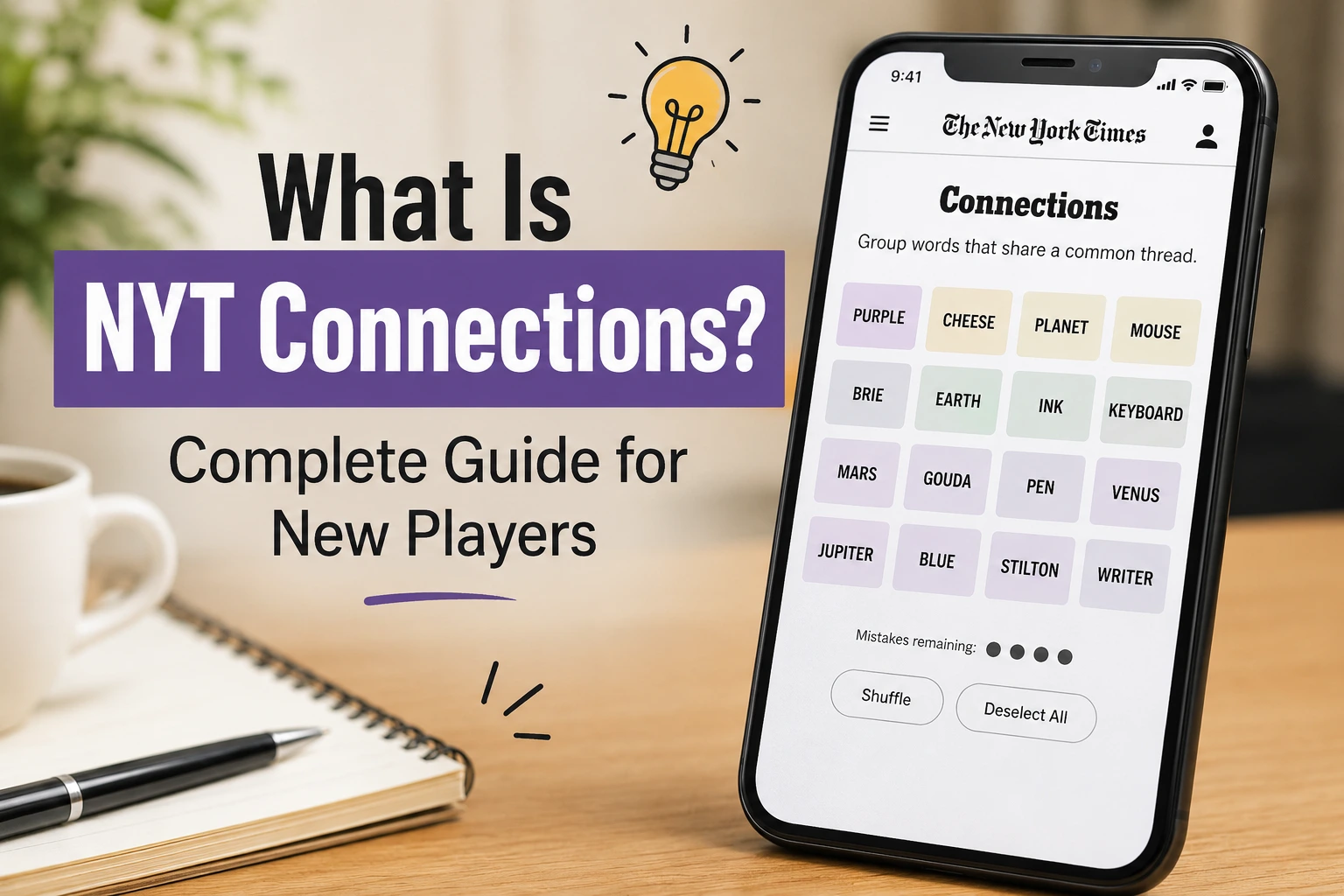
Each daily puzzle on the official NYT Connections game shows sixteen words in a grid. Your job is to sort them into four groups of four, where each group shares something in common. Select four words and submit. If they form a group, those words lock in and leave the board. If not, you lose one of your four mistakes. Lose all four and the puzzle ends unsolved. A reliable connections strategy starts with respecting those four mistakes, because every careless guess spends one.
Groups are color coded by difficulty once solved. Yellow is the most straightforward, then green, then blue, and purple is the trickiest. Knowing the colors helps you decide where to spend your effort: secure the easy groups first, then attack the hard ones with a smaller board.
The Four Difficulty Colors Explained
Think of the colors as a difficulty ladder. Yellow groups use plain, direct categories that most players see quickly. Green groups need a small leap, like words that share a less obvious trait. Blue groups often play on words with double meanings. Purple groups are built on wordplay, like words that precede or follow the same word, or words that sound alike. A smart connections strategy works up this ladder: bank yellow and green early, which shrinks the board and makes blue and purple far easier to see.
Do not chase purple first. It feels clever, but purple groups are designed to look like something else. Solve what is certain, and let the shrinking board reveal what is hidden. This discipline is the heart of good connections strategy.
Start With the Obvious: Lock In Easy Groups First
Scan the board for the most boring group first. Four words that are clearly the same kind of thing, like four colors or four animals, are almost always the yellow group. Submitting a certain group costs nothing and removes four words, which is the single most valuable move in any connections strategy. Fewer words means fewer distractions and fewer chances for red herrings to fool you.
After the first group locks in, scan again for the next most obvious set. Two easy groups solved means half the board is gone, and the remaining eight words can only form two groups. The puzzle gets dramatically simpler with every group you bank. Repeat this process and your connections strategy will feel automatic.
How to Spot Red Herrings Before They Cost You
Red herrings are words that seem to belong to a group but actually belong elsewhere. The editors place them deliberately, often three words that look like a set plus one outsider. If you see what looks like a group but one word feels slightly off, stop. A careful connections strategy treats almost groups as warnings, not invitations. Look at the odd word and ask what else it could join.
A useful test: can you name the category in plain words? If you can say exactly what connects your four words, submit with confidence. If you can only say they feel related, keep looking. Vague connections are where red herrings live. This simple test is the most reliable part of any connections strategy.
The Shuffle Button Is a Strategy Tool
The shuffle button rearranges the sixteen words on the board, and serious players use it constantly. Words that sit near each other create false patterns in your mind, so shuffling breaks those illusions and lets you see fresh combinations. Make shuffling part of your connections strategy: hit it whenever you feel stuck, and again after each solved group to view the smaller board with new eyes.
Shuffle also helps when one word keeps pulling your attention toward a wrong group. Moving it across the board weakens that mental link and frees you to consider its other meanings. Use it freely, because a flexible connections strategy beats a rigid one.
When to Guess and When to Wait
Guess only when you can state the category clearly and all four words fit it with no stretch. If two words are certain and two are maybes, do not submit. Instead, look for what the certain pair rules out, and let the board narrow your options. Patience is the core of winning connections strategy, because a wrong guess costs a mistake while waiting costs nothing.
Pay attention to the one away message. When the game tells you that you are one word off, you have three correct words and one wrong one. Do not resubmit the same three with a random fourth. Swap each of the three out in turn and test which one does not belong.
Common Traps That Break Streaks
Most failed boards fall into a few familiar traps.
- Submitting the first plausible group without checking for red herrings. The obvious set is often bait.
- Ignoring double meanings. Many words have two or three senses, and the group uses the one you did not think of first.
- Burning mistakes early on guesses. Each lost mistake makes the rest of the board harder to play calmly.
- Forgetting wordplay categories. Purple groups love prefixes, suffixes, homophones and words that go before or after a shared word.
- Locking onto one interpretation of a word. If a word will not fit anywhere, list its other meanings until one clicks.
Notice the pattern: every trap punishes rushing. Our guide to common Nerdle mistakes shows the same lesson in a numbers game, and our how to play Dordle guide teaches patience across two grids. Connections simply hides its traps in words.
A Daily Routine That Builds Pattern Recognition
Play the daily puzzle on the official NYT Connections game site and spend two minutes reviewing each board after you finish. Note which group you found first, which red herring almost caught you, and what the purple group was really about. Most players discover one recurring weakness: rushing yellow, missing wordplay, or ignoring double meanings. A focused connections strategy improves fastest when you fix one weakness at a time.
Keep a short list of category types you have seen, like words before a shared word or members of a set. Editors reuse category shapes even when the words change, so your list becomes a cheat sheet for future boards.
How Connections Differs From Wordle Style Games
Wordle style games test your vocabulary and letter logic one word at a time. Connections tests how you handle ambiguity across sixteen words at once. There is no letter feedback and no process of elimination through guesses. Instead you must hold multiple possible meanings in mind and commit only when certain. That makes connections strategy more about reading comprehension than word knowledge, which is good news if your vocabulary is average but your logic is strong.
Cross training helps. Learning the best Quordle starting words sharpens the systematic thinking that Connections also rewards, and learning to share Wordle results with friends adds a social streak worth protecting.
Frequently Asked Questions About Connections Strategy
These are the questions players ask most about connections strategy.
How many mistakes can you make in Connections?
Four. Your fourth wrong guess ends the puzzle, so a careful connections strategy treats every guess as precious.
What do the colors mean in Connections?
They show difficulty: yellow is easiest, then green, then blue, then purple. Solve yellow and green first to shrink the board.
What is a red herring in Connections?
A word placed to look like it belongs to a group it does not. Editors use them to punish rushed guesses.
What does one away mean?
Three of your four selected words are correct and one is wrong. Swap words out one at a time to find the intruder.
Is NYT Connections free to play?
Yes, with a free account on the New York Times games site. The daily puzzle refreshes every day.
Where can I find more Connections guides?
Start with our NYT Connections guides section for more lessons that sharpen your connections strategy.


42 Comments