

Nerdle First Guesses: Smart Openers for Math Puzzles
Nerdle first guesses decide how hard or easy the rest of your puzzle will feel. In Nerdle you get six attempts to find a hidden eight character equation, and your opening guess is the only one you make with zero information. A smart opener tests the most useful digits and operators at once, while a lazy opener wastes your best chance to learn.
This guide explains how to choose nerdle first guesses that actually help, what makes an opener strong, and the mistakes that make guess one useless. You will learn how to balance digits and symbols, how to read what your opener tells you, and how to turn a good start into a fast solve.
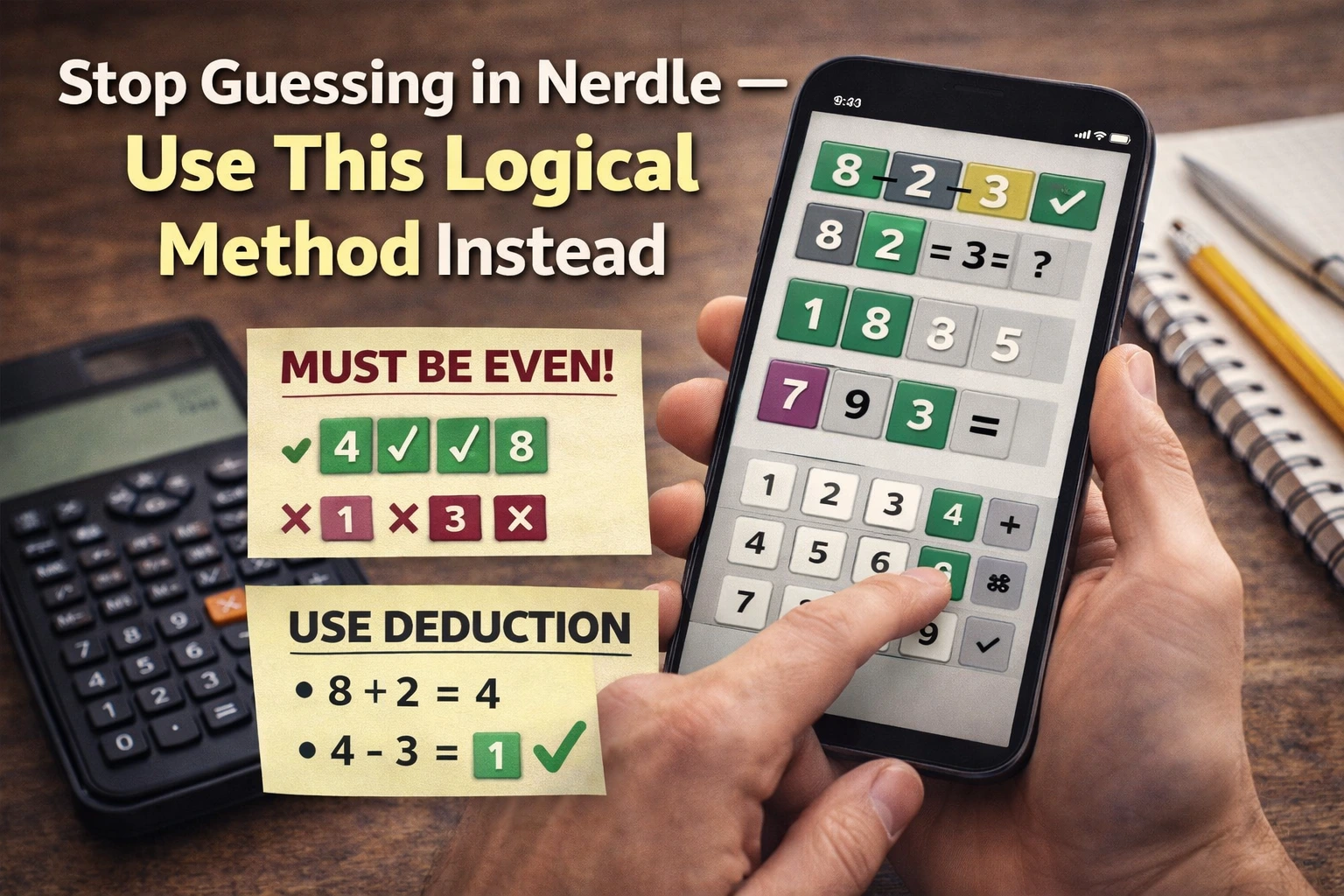
Why Nerdle First Guesses Matter More Than in Wordle
In Wordle, any five letter word is a legal guess, so your opener mainly tests letters. Nerdle is stricter. Every guess must be a valid equation with correct math, which means your nerdle first guesses must satisfy the rules while also gathering information. That double job makes opener choice far more important.
A strong opener in Nerdle can reveal the position of the equals sign, confirm or rule out two operators, and test five different digits in a single move. No later guess can match that information haul, because later guesses must work around what you already know.
How Nerdle Scoring Works in Thirty Seconds
Each Nerdle guess fills eight tiles with digits and symbols. Green means the character is correct and in the right spot, purple means it appears in the equation but elsewhere, and black means it does not appear at all. Your nerdle first guesses exist to earn as many colored tiles as possible.
The equals sign is the anchor of every equation. Finding its position early splits the puzzle into a left side to solve and a right side to check, which is why the best nerdle first guesses always pin down where the equals sign sits.
The Anatomy of a Great Nerdle Opener
Great nerdle first guesses share three traits. First, they use two different operators, because most Nerdle equations contain two operations and testing both early is efficient. Second, they use five or six different digits with no repeats, maximizing the numbers you check in one move.
Third, they place the equals sign in a position that matches common equation shapes. An opener that respects how real equations look will earn more greens and purples than one that guesses a strange layout. Memorize one opener with these traits and use it every day.
Smart Nerdle First Guesses to Try
The best nerdle first guesses are the ones you understand deeply, so pick one style and master it. One popular style opens with addition and subtraction plus a spread of low and high digits. Another style leads with multiplication to test a less common operator right away.
Whichever style you choose, keep it consistent for at least twenty games. Our Nerdle tips guide explains why sticking with one opener beats rotating randomly, since you learn exactly what each color pattern means for your second guess.
Balancing Digits and Operators in Guess One
Beginners often fill their nerdle first guesses with too many digits and only one operator, or the reverse. The sweet spot is two operators, one equals sign, and five unique digits. This balance tests the full structure of the equation in a single move.
Think of guess one as a survey, not a solution. You are mapping the territory. Digits tell you which numbers live in the equation, operators tell you the shape of the math, and the equals sign tells you where the answer begins. A balanced opener surveys all three at once.
What Your First Guess Reveals About the Equation
Reading your opener result is a skill of its own. Two green operators mean the equation shape is nearly solved, so your next guesses can focus on digits. A black equals sign in your guessed position is actually great news, because it eliminates a whole family of layouts.
Purple digits are the most valuable result of smart nerdle first guesses. Each purple digit is confirmed to exist, so your job becomes placement rather than discovery. The ultimate Nerdle strategy guide shows how to convert purple tiles into solved equations in two moves.
Common First Guess Mistakes to Avoid
The worst mistake in nerdle first guesses is repeating digits. Every repeated digit is a wasted tile that could have tested a new number. Check your opener for duplicates before you commit to it as your daily habit.
Another mistake is using an opener that breaks Nerdle rules, like an equation with incorrect math or a leading zero where it does not belong. Test any new opener on the official Nerdle site first. The game will reject invalid guesses, and learning this during a real round costs you a precious attempt.
Adapting Your Opener to Different Nerdle Modes
Classic Nerdle uses eight tiles, but mini and other modes change the length. Your nerdle first guesses must fit the mode you are playing. A shorter board needs fewer digits and often only one operator, so build a separate opener for each mode.
The principles stay the same across modes. Maximize unique characters, test the most likely operators, and pin down the equals sign early. Players who keep one trusted opener per mode solve faster than players who improvise every game.
From First Guess to Solution: A Simple Framework
After strong nerdle first guesses, follow a simple framework. Guess two locks in the equation shape using what guess one revealed. Guess three and four place the remaining digits. Guess five and six are for careful solving, not exploring.
This framework works because it separates the game into phases. Information gathering happens early, and deduction happens late. Our pillar on common Nerdle mistakes shows what happens when players mix these phases and guess wildly in the late game.
Frequently Asked Questions About Nerdle First Guesses
Should I use the same opener every day?
Yes. Consistent nerdle first guesses let you learn exactly what each result pattern means, which makes your second guess much stronger over time.
Can my first guess be wrong mathematically?
No. Nerdle rejects any guess that is not a valid equation, so your opener must contain correct math or the game will not accept it.
How many digits should my opener include?
Aim for five or six unique digits in classic eight tile Nerdle. Unique digits give you the most information per guess.
Is it bad if my opener gets all black tiles?
Not at all. All black tiles from smart nerdle first guesses still eliminate five digits and two operators, which massively narrows the search.
Where can I practice my opener?
Play daily on the official Nerdle site and test variations without pressure until your opener feels automatic.
Smart nerdle first guesses will not solve the puzzle for you, but they make every later guess easier. Pick one balanced opener with two operators and unique digits, learn what its color patterns mean, and trust the framework of shape first and digits second. Practice it daily on the official site. Within a few weeks your nerdle first guesses will turn from hopeful stabs into the most reliable move in your entire game.


9 Comments