

Common Nerdle Mistakes That Ruin Your Score
Every Nerdle round gives you six guesses to find one hidden equation, yet most players waste at least two of them on avoidable nerdle mistakes. Math puzzles punish sloppy logic more than word puzzles do, because every guess must obey strict arithmetic rules. Learn the errors below and your scores will improve within days.
Why Nerdle Mistakes Snowball So Fast
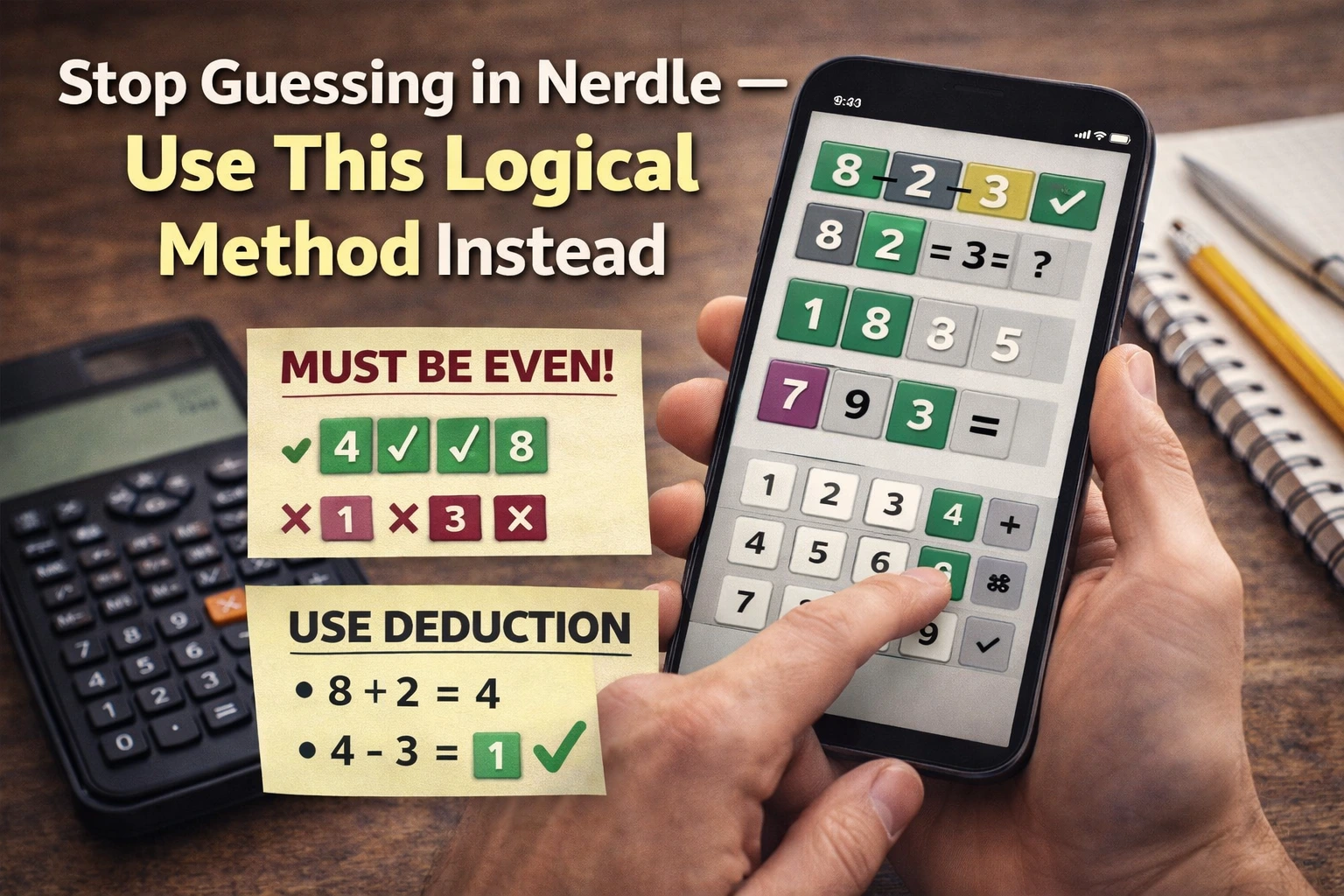
In Wordle a wasted guess still reveals letter colors you can use. In Nerdle a wasted guess often reveals nothing new, because the equation you tried repeated information you already had or broke a rule you already knew. Six guesses sounds generous until two of them teach you nothing. That is why nerdle mistakes are so costly. Each one does not just lose a turn, it shrinks the information you carry into the final guesses where precision matters most.
The players who score well in Nerdle are not human calculators. They are simply disciplined. They never test the same idea twice, they respect the order of operations, and they treat every tile color as a fact to obey. If you fix the seven nerdle mistakes below, you will join them, even if arithmetic was never your favorite subject.
Mistake 1: Testing Both Orders of the Same Sum
Addition commutes, which is a fancy way of saying that 12 plus 34 equals 34 plus 12. Many players learn that certain digits belong in the equation, then burn a whole guess checking the reverse order. That guess cannot teach you anything new, because if the digits are right then both orders are mathematically valid, and only the tile colors reveal the true positions. This is one of the most frequent nerdle mistakes because it feels productive. It is not. When purple tiles tell you certain digits are present, your next guess should place them in new positions while testing fresh digits elsewhere, never simply flip an addition you already know works.
Mistake 2: Forgetting the Order of Operations
Nerdle follows the standard order of operations, so multiplication and division happen before addition and subtraction. Players constantly misread their own guesses because they evaluate left to right like a sentence. A guess such as 2 plus 3 times 4 equals 14 is valid, since 3 times 4 is 12 and 2 plus 12 is 14. But if you read it as 2 plus 3 equals 5 and then 5 times 4, you will misinterpret every tile color that follows. Before you submit any guess, evaluate it the way Nerdle does. This single habit removes a whole family of nerdle mistakes, because most complaints about impossible feedback come from players who scored their own equation incorrectly.
Mistake 3: Reusing Digits Nerdle Already Ruled Out
A black tile means that digit or symbol does not appear in the hidden equation at all. Yet players keep reusing dead digits because they build equations around familiar numbers. Every dead digit you reuse steals a slot that could test a fresh candidate. Treat black tiles as locked doors. When you catch yourself typing a digit you know is dead, stop and rebuild the guess. Among all nerdle mistakes, this is the easiest to fix and the most frustrating to keep making, because the game already told you the answer does not contain that character.
Mistake 4: Opening With a Digit Poor First Guess
Your opener should maximize new information, which means many unique digits and at least two different operators. Guesses full of repeated digits test only a handful of distinct characters and teach you almost nothing. A strong opener spreads across the digit range and includes both an addition or subtraction and a multiplication or division. Think of your first guess as a survey of the whole equation space. Players who plan their opener in advance avoid one of the costliest nerdle mistakes, the empty first guess that leaves guess two with no direction.
Mistake 5: Misreading Purple Feedback
Purple means the character is in the equation but in the wrong position, while green means it is exactly placed. The classic error is treating purple as green and locking the digit where it sits, or treating purple as black and abandoning a digit the game confirmed. When you see purple, your job is clear. That character must appear in your next guess in a different slot. Write down your confirmed characters on paper or in a notes app if you play on mobile. This tiny habit prevents some of the most stubborn nerdle mistakes, the ones where players insist the game is wrong while their own notes prove otherwise.
Mistake 6: Wasting Late Guesses on Long Shots
Guesses four through six are for solving, not exploring. By guess four you should have most digits placed and be testing arrangements, not throwing in wild new operators. The mistake looks like this. With two guesses left, a player tries a completely fresh equation just to see what happens. That guess cannot win, because even if every tile turned green you would have spent the turn learning instead of answering. Disciplined players flip a switch after guess three. From there, every guess must be a genuine candidate for the hidden equation. This discipline separates consistent winners from players who blame luck for their nerdle mistakes.
Mistake 7: Playing Every Round the Same Way
Some players use the identical opener and identical follow ups daily, then wonder why tricky equations stump them. Nerdle varies its hidden equations across operations, digit counts and structures. If your system only handles addition heavy equations, division based rounds will crush you. Rotate your openers across the week and deliberately practice your weakest operation. Variety builds the flexibility that fixed routines never will. The final entry in our list of nerdle mistakes is really a meta mistake, refusing to adapt. The game changes daily, so your approach should too.
A Simple Routine That Eliminates Nerdle Mistakes
Try this five minute routine for one week. Play each round on the official Nerdle game site with a planned opener, then pause before guess two and list what each tile color proved. Write the confirmed digits, the dead digits and the purple digits that must move. Build guess two only from that list. Most players discover that slowing down for thirty seconds removes nearly all of their nerdle mistakes, because errors thrive on rushed typing, not on hard math.
Review your week in our Nerdle guides section and compare your approach across rounds. You will spot your personal pattern fast, whether it is commutative flips, dead digit reuse or purple misreads. For broader puzzle discipline, the best Quordle starting words guide teaches information first thinking that transfers to any puzzle, and learning how to share Wordle results lets you compare scores with friends for accountability.
Frequently Asked Questions About Nerdle Mistakes
What is the single most common of all nerdle mistakes?
Reusing digits that black tiles already eliminated. It wastes a full guess and gives zero new information, yet almost every beginner does it weekly.
Should I trust the math or trust the tile colors?
Trust the tile colors, but only after you verify your own guess follows the order of operations. Most confusion comes from misreading your own equation.
How many openers should I prepare?
Three is enough. Build one addition heavy, one multiplication heavy and one balanced opener, then rotate them through the week.



15 Comments