Worldle Map Memory: 8 Proven Ways to Memorize Every Region
Worldle map memory is the ability to picture every region of the world map in your head before you guess. Players with strong map memory read a silhouette and instantly know which corner of the globe it belongs to, while weaker players waste guesses exploring dead ends. Your memory is the real game board.
This guide gives you 8 proven ways to build worldle map memory that lasts. You will learn how to chunk the map into regions, attach shapes to names, and drill recall until every outline triggers an answer. When your map memory is sharp, the silhouette feels like an old friend.
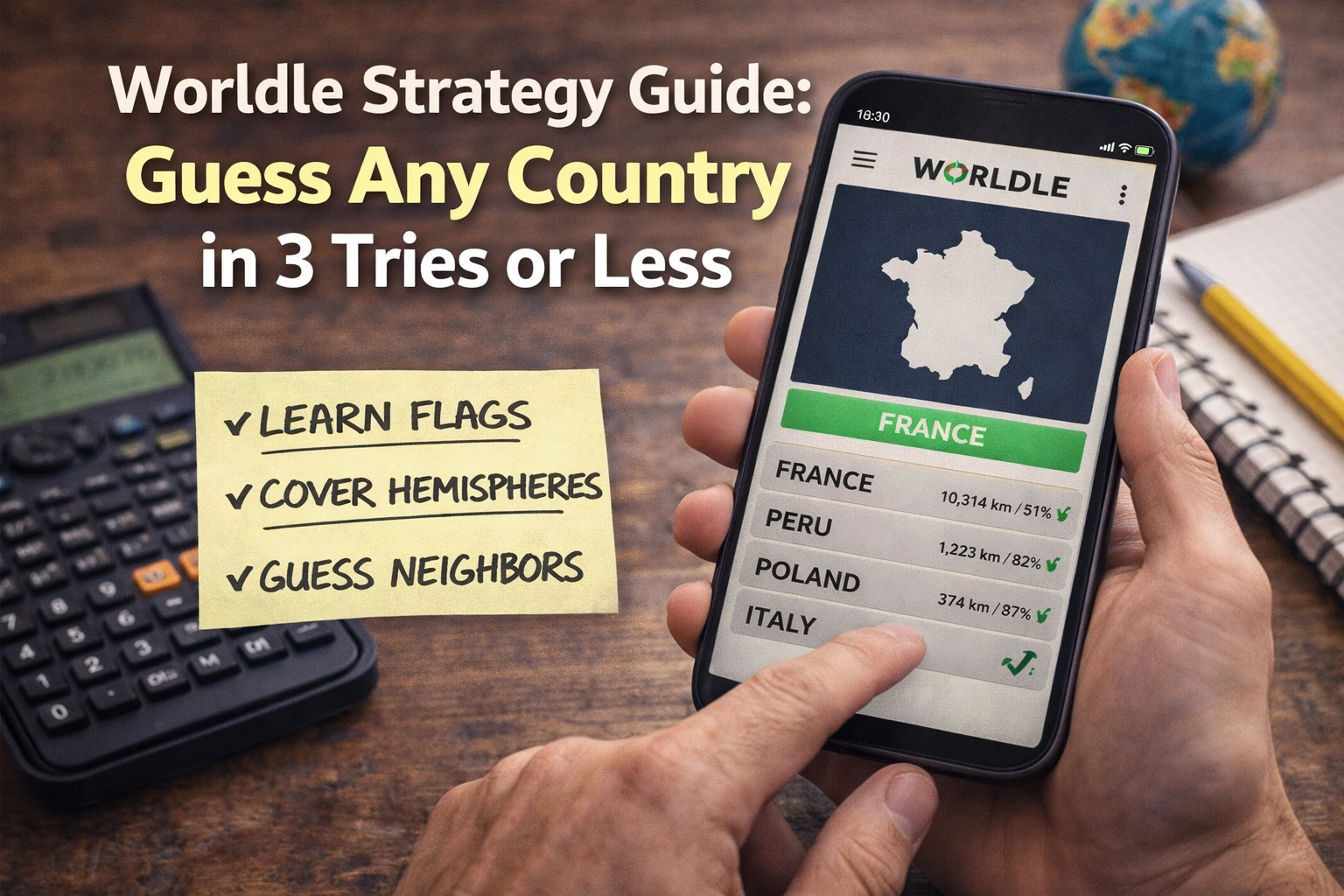
Why Worldle Map Memory Matters
Worldle tests recognition, not trivia. The distance and arrow clues help, but the fastest solvers recognize the shape before the first clue. Strong worldle map memory turns the silhouette into a name in seconds, saving your guesses for the rare puzzles that truly confuse you.
Memory also calms your nerves. When you trust your mental atlas, hard shapes feel like puzzles instead of threats. A player with solid worldle map memory plays loose and confident, which itself sharpens guessing.
Start building with the outlines you already know. Our Worldle country shapes guide gives you the visual families that anchor new memories.
Way One: Chunk the Map Into Seven Zones
Divide the world into seven mental zones: North America, South America, Europe, Africa, Middle East, Asia, and Oceania. When a silhouette appears, first name the zone, then search inside it. Zone first thinking is the foundation of worldle map memory.
Practice naming the zone for ten random silhouettes a day. Speed at the zone level matters more than precision, because the right zone cuts the candidate list by eighty percent. Our Worldle continent clues guide drills the same skill.
Draw the seven zones from memory once a week. A worldle map memory that can sketch the zones owns them, and the act of drawing locks them in.
Way Two: Attach One Visual Hook to Each Country
Give every tricky country a visual hook, a single feature that identifies it. Italy is the boot, Chile is the ribbon, Japan is the curved chain. One hook per country beats a perfect mental picture for worldle map memory.
Invent silly hooks for the countries that keep fooling you. The sillier the hook, the stickier the memory, and personal hooks beat textbook ones. Review your hooks in our Worldle practice mode drills.
Write the hooks in a notebook next to the country names. Rewriting is rehearsal, and the notebook becomes your personal worldle map memory atlas.
Way Three: Learn Neighbors in Chains
Memorize countries as chains rather than isolated facts. Walk the west coast of Africa from Morocco to South Africa, naming each country in order. Chains give your worldle map memory a path to follow when a silhouette lands in a fuzzy region.
Build one chain per week until you cover the map. Start with regions that appear often in your games, because frequent use cements the chain fastest. Our Worldle Africa countries guide is a good first chain.
Test the chains backwards too, because Worldle can start from any point. A chain that runs both ways is twice as useful for worldle map memory.
Way Four: Pair Shapes With Continents
Store each outline together with its continent, because the pair recalls faster than the shape alone. A long thin shape in South America means Chile, while a similar shape in Asia means Vietnam. Continent context is half of worldle map memory.
When you miss a country, restudy the shape with its continent label attached. Most misses come from right shape wrong region thinking. Our Worldle map reading guide trains shape plus region scanning.
Quiz yourself with shape cards sorted by continent. Sorting forces the pairing, and the pairing builds worldle map memory that survives pressure.
Way Five: Drill the Confusing Pairs Daily
Every player has confusing pairs: countries whose shapes look alike. List yours and drill them side by side every day until the difference is obvious. Targeted drilling is the fastest way to grow worldle map memory.
Focus on the single feature that separates each pair, like a notch, a peninsula, or an island. One distinguishing feature per pair is enough. Our Worldle zoom technique guide helps you spot the tiny difference.
Retire a pair only after ten correct identifications in a row. That streak proves the worldle map memory is real, not a lucky guess.
Way Six: Use the Distance Clues as Memory Checks
Treat every distance number as a quiz for your mental map. Before reading the number, estimate how far your guess was from the region you pictured. Comparing estimate to reality calibrates your worldle map memory fast.
When the number surprises you, the mental map was wrong in a specific spot. Mark that spot and restudy it, because surprises are the most valuable memory feedback. Our Worldle distance clues guide turns numbers into teachers.
Keep a list of your worst distance estimates. Each entry is a hole in your worldle map memory with a signpost on it, waiting to be filled.
Way Seven: Review Misses Within 24 Hours
Memory hardens in the first day after a mistake. Review every missed country within 24 hours, restudying its shape, zone, and hook. Fast review multiplies the value of each worldle map memory lesson.
Use a simple review ritual: shape, zone, hook, neighbor chain. Four steps, one minute per country, and the miss becomes a strength. Our Worldle results analysis guide gives you the full template.
Space the reviews out: one day, one week, one month. Spaced repetition is the proven engine of long term worldle map memory.
Way Eight: Teach the Map to Someone Else
Explaining a region to a friend forces your memory to organize itself. Teach the chains, the hooks, and the confusing pairs out loud. Teaching is the ultimate worldle map memory test, because gaps appear the moment you try to explain.
Play together and narrate your thinking for every guess. Saying the zone, the shape family, and the hook out loud rehearses the full recall path. Our Worldle challenge friends guide turns teaching into a game.
Write short explainers for your hardest regions. If you can teach it clearly, your worldle map memory owns it.
Frequently Asked Questions About Worldle Map Memory
How long until my map memory improves? Most players notice faster zone calls within two weeks of daily drilling. Full shape recall builds over a few months of steady practice.
Do I need to memorize every country? No, focus on the countries that appear in your games plus their neighbors. Practical worldle map memory beats encyclopedic knowledge.
What if I am bad at geography? Start with the seven zones and one hook per familiar country. Everyone starts somewhere, and the system works from any level.
Can I just use the clues instead of memory? Clues help, but memory is faster and saves guesses. The best players pair strong worldle map memory with smart clue reading.
Memorize Every Region Like a Pro
Tomorrow, name the zone before you guess, attach a hook to one tricky country, and drill one confusing pair. When your worldle map memory grows daily, the silhouette stops being a mystery.
Extra Worldle Map Memory Habits
Glance at a world map for two minutes before each game. The fresh image primes your worldle map memory, and the daily game becomes a recall exercise instead of a cold start.
End each week by redrawing your weakest zone from memory. The drawing exposes gaps that guessing hides, and filling them is the fastest way to level up.
Warm up with our Worldle warm up routine guide, which pairs map priming with your daily game for stronger recall.
More Worldle Map Memory Study Ideas
Deepen your mental atlas with our Worldle clues pillar and test your recall on the official Worldle site until every region feels familiar. Try a month of map memory drills and watch your scores climb.